Day six was the last day of the conference, and our last day in Delhi; we therefore had so many activities to pack in that by the end of it, I was so sick and tired that I crashed into bed as soon as we got back to our hotel (around ten), and have woken up early this morning (six) to write about it. We'll leave Delhi today at nine, when Matkhan, our driver, will hand us over to his friend (another Punjabi Sikh), who will drive us to Jaipur (where we'll stay for two days), to Varanasi (where we'll stay another two days), to Agra (where we'll stay one day, to see the Taj Mahal), and then back to the airport for our flight to London. Writing that all out, it becomes clear that we'll be here practically another entire week, but when I woke up yesterday morning, the morning of Day Six, I felt sick and exhausted; I had the same pounding headache I've had every morning (probably due to sinus pressure from the pollution here, and the back and neck ache from sitting all day, and not practicing vigorous yoga. I also had pervasive nausea all day, probably also from the pollution, since the food has been so nice. Anyway, I woke up and wished, for the first time so far, that I was going home. Mom, on the other hand, who didn't feel at all comfortable here the first few days, is now meshing with the environment, and quite loving the Indian people. I certainly don't want to go home to the extent that I would cut the trip short, but India is an emotionally and physically exhausting place, and I will have to look for a second wind if I'm to make it.
That said, yesterday was really delightful. We started the morning as early as we have been, with breakfast as soon as the hotel club opens at 6:30, newspapers, and a quick cup of tea before going to the Habitat Center for yoga. I have become increasingly frustrated with CNN, which plays here in the club room (where I'm writing now, as breakfast is again prepared) on two plasma televisions, since it has a tendency to flash phrases of quite disturbing breaking news ("Five bombs in five hours in Bagdhad;" and "Iranian ships announced "we will blow you up,") while playing some nonsense—an expose on digital cameras, for instance—instead of telling me what the hell is going on. Plus, the only non-local newspaper we get here is the International Herald Tribune, and the copies are always a few days late. That said, I have the internet, and it seems as if no actual disasters are occurring. So anyway, we went to yoga, where Swami-gi at long last taught us some standing poses (although did them in a very unpleasantly unorthodox (dare I say lazy?) manner). We did no forward bends, and my body still felt like a wreck afterward, when I walked into a panel session on Holotropic Therapy.
I didn't (still don't?) know what holotropic breathwork actually is, but it was designed by Stan and Christina Grof, founders of Transpersonal Psychology (one of the cornerstones of this conference). The presenters actually assumed that we already knew what the therapy consists of (indeed, most of the people there did, being holotropic therapists themselves), and so rather than explaining in too much detail what happens in a session (which might last three or four hours, and in which clients are paired with other clients. One client breathing while the other client "sits"—is available for that breather in any necessary way. Stan Grof developed this breathwork after having an epiphanic LSD experience in the 1960s, and I can't help but think of the sitter as the guide who might sit with someone tripping, to take care of them and talk them out of a bad trip, if necessary. In fact, holotropic breathwork has been tainted by it's connection with LSD, although drugs are not used in the process, which instead uses more intensive breath to generate energy and access more powerful states of consciousness, along with music and advanced bodywork to support the process. The underlying premise here is that the breath is the manifestation of consciousness, and that when there are troubles in the consciousness, they manifest themselves in the breath; we therefore can work with our energy by working with our breath. One speaker discussed her work, which combines the breathwork with water's healing powers, which she calls Aquanima (aqua for water, anima for spirit). The breathwork is here performed in a hot pool, rather than a mattress, for an increased sense of security, connection to the source, and boundary-less-ness (the water and air are the same temperature as the human body). The best quote that came out of this session was this: "symptoms are not things that you try to eliminate, but are essential parts of our energy—they are a storage of knowledge." I've recently come to this conclusion myself in dealing with chronic pain in my shoulder; I spent five years having massages, going to doctors, and trying physical therapy until I realized that the pain was trying to direct my attention to the lack of support and breath I give to the right side of my body (have you seen me sitting lately? I'm rather lopsided.) I just hope it doesn't take me another five years to find space inside, but the pain, the symptom, is with me as a constant reminder, every time I slouch into old physical habits.
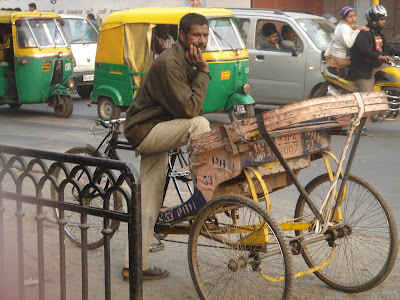
After the first panel and tea break, mom and I had decided to take a break from the conference and do a bit of shopping and sightseeing with Matkhan. She had a long list of friends for whom she needed to shop (she always expresses her love by bringing carefully chosen gifts back to her co-workers, and puts much more intention into any purchase than I ever had), and I refused to leave Delhi without seeing at least the Red Fort and Old Delhi. First, we went to Old Delhi, where our driver told us he couldn't drive there, and we would have to get out of the car and take a free tricycle rickshaw to see the fort. We were a bit confused, but piled into a tiny rickshaw (not meant, I imagine, for two passengers), and the scrawny but surprisingly strong driver pedaled us at a fast clip through the crumbling streets of Old Delhi. I used my left hand to grip the side of the rickshaw while all of the explosive colors and teeming poverty of India swirled around me; I used my right hand to hold my camera, and take shot after shot, literally "on the fly," getting whatever pictures I could; this trip, for me, has been a series of pictures that I've missed, but I think I've managed to get some that still evoke the place quite well. I will try to post some of Old Delhi here tonight.
The Red Fort was the least interesting part of the ride; the rickshaw stopped and I got out to take one picture, and was ready to get back in, when a tiny waif with bare feet and a baby in her arms (her sibling, I imagine; the girl couldn't have been older than ten), dust covering her body and worn, draping clothes, came up to me saying "Ma'am, ma'am," and gesturing first to her mouth with a hand, and then holding the hand out for money. This is the gesture that we have seen throughout our trip from begging children. At the conference the day prior, my mom had asked an Indian woman, who lives in Pondicherry, why children were begging in the streets. She explained that these children come from a tribe in Rajasthan, where their way of life is to live in groups on the streets. A number of families will be controlled by one man, she called him a "gang leader," who sends the women and children into the streets to beg. The men don't work, but sleep all day in the sun, and also drink alcohol. The women and children have to bring all of the money they collect back to the gang leader. Another Indian confirmed this in a later conversation. I have had some comments from you, dedicated readers, about my unwillingness to hand out money, but it is precisely for a reason such as this that I have refused to do so. In discussion later, mom and I had decided that we would fill our bags with the fruit given to us at the hotel, and hand that out in the streets if any more hungry children came to our car. At least then, they could actually eat, and not have to turn their earnings over to their pimp, if you will. And so, when this girl approached me, I pulled a big red apple from my bag, and handed it to her. Her eyes flashed with malice, and she pointed to the baby, and gestured for money again. Then she called for her mother, who came up with another baby, and asked me for money. Meanwhile, my mom was ten paces away, bargaining with a hard-driving man for a tiny wooden backgammon set. I was running away from the relentless begging women, filled with frustration and sadness and anger that my gift hadn't been accepted more graciously, and fear and disgust and rage were welling up inside me as I insisted that we get back into the rickshaw, buy nothing, and return to Matkhan. My mom wanted rupees to buy the backgammon set and I kept shouting "No!" to her, as if I had that authority (although I was in sole possession of our rupees). We got into the rickshaw, while she continued to ask me why I wouldn't give her the money, and while I kept shouting "No!" to her and to the salesman and to the women and children and babies, all of whom were crowded around us. I told our driver to go, and we all kept shouting; the salesman running alongside us dropping his price instantaneously from $20 to $15 to $10 to $5, the girls shouting "Ma'am, ma'am!" and running, barefoot, the baby bouncing, mom demanding that I give her 20 rupees, and me shouting "No no no no no!" continuously to everyone, rather out of control. This all went on for quite some time, since our driver couldn't pedal very fast with two passengers, and the people continued to run alongside us tirelessly. After we had gotten away from the bowls of Old Delhi and closer to Matkhan and his car, I finally relented and gave my mom INR 200 in small bills, because my adrenaline levels had receded to normal and I was no longer afraid to open my bag and take out my wallet (I had imagined before, just seeing the swarm the apple had generated, even the swarm my picture-taking generated the day before, when I walked on foot through streets full of men who looked at me like they'd never before seen a white lady, the swarm that would be generated if my mom began giving rupees to one salesman; our rickshaw, hardly a protective mode of transport, would be penned in by tens of pressing bodies, shouting to sell something. I was afraid.
Once in the safety of the car, I was able to relax; Matkhan took us back to the store where we had bought paintings the day prior, and on the way we asked him to stop when we saw a dinky store on the corner that said "Jewellery and Silk" in peeling paint on the wall. I used to love Indian jewelry, but I don't wear any jewelry anymore at all. My mom still does though, and loves the local style; she had promised to bring earrings to a number of her girlfriends, but we had been astonished at the prices in the clean, well-lit, hard-bargaining tourist shops our driver had been taking us, despite our complaints. He didn't seem to want to stop here, but did anyway. At last, we saw the metal cuff bracelets, danging earrings, and huge necklaces that we had been looking for, at 1/10th the prices we'd seen previously (mind you, the tourist shops were selling silver, while these items were in white metal, but we prefer the look and feel of white metal anyway; we buy jewelry for aesthetic reasons, not investment). This shop, of course, only took cash, so Matkhan and I went on a walk, looking for an ATM, while mom stayed on to make her choices. These were the same streets where I had taken pictures the day before, so I concentrated on finding money instead of photographs. I did see one ancient man wearing orange robes, bald, brown, and with a matted white beard to his waist, but when I raised my camera to take his picture, he covered his face with his garment, and waved me away. He is the first person who hasn't wanted his photo taken, and I respectfully turned away.
I went to three different ATMs to find one that would give me money, and when the 10,000 requested rupees (about $250—what I take out every week or two in New York) came out of the machine, everyone around, Matkhan included, stared, aghast. We went back to the shop, finalized our purchases (six bracelets, a necklace, a statuette, three pendants, and a bronze ganesh head to hang on the wall, all for INR 5,250, around $140), and went back to the art shop, where we chose five painted miniatures to bring back to friends; our salesman welcomed us with tea for mom and a diet coke for me (something I loathe, but I hadn't eaten since six-thirty, and it was nearly two, and after all of the hormone rushes of the day, I was feeling rather faint, and though the sugar would do me well; I requested a coke, but diet was brought, and I wasn't about to complain). We picked out our paintings, which were INR 1,000 a piece (already discounted from INR 12,000). I didn't have the energy to spend another hour haggling, so was thrilled when, after I told the salesman that he should give us all five for a hundred bucks, or INR 4,000, he said, "OK" with a secret smile, and wrote up the receipt. Whew.
Now, Matkhan took us back to the conference, because the video presentation from BKS Iyengar, which was originally scheduled for the first day, when we ran out of time, was scheduled to play at four o'clock. On the way there, a boy, maybe ten years old, came up to our car's window in the traffic, asking for money. My mom rolled down the window and handed him an apple. He took in both hands and held it tightly, 1000 watts of smile spreading across his face. He waved it in the air to show his friends, grinning, and then the car drove away.
Iyengar is probably the most important yogi alive—sort of a yoga celebrity, if there can be such a thing; I've read one of his books and I love his imagery and insight. I had been looking forward to meeting him (he was originally supposed to present at the conference in person), and now had to make do with this video presentation. We walked into the auditorium and caught the tail-end of a session on Education, and heard some people make rather "out there" comments about what a travesty it is that spirituality is scorned by the public school system in the US, and that there out to be, in every classroom, images of all different deities from the worlds' religions, so that children can find something to grasp onto, and verify their spiritual impulses. My response is that children's minds are controlled enough in schools as it is, without adding the excesses of religion, and that furthermore, they are creative enough that, if they have spiritual tendencies, they will find their own original mode of expression (far superior, I believe, than latching onto someone else's). Of course, I am an anti-religionist, but I doubt that the answer to the problem of faith and school is "all" rather than "none," because "all" is a logistical nightmare; since pictures of Kali and Buddha and so on offend the monotheistic traditions of Christianity, Judaism, and Islam, it is, ultimately, not possible for these images to coexist in a public space. In a classroom, they would all be reduced to mythology anyway (which is what I personally consider them to be).
After this discussion, we had a quick tea break (a few cookies, I hoped would kill the gnawing twin pains in my stomach and head), and then reconvened to watch BKS Iyengar. His beautiful, strange old face, like a carved block of wood, came onto the screen, and he immediately jumped into his thesis—that there is a gap between psychology and spirituality (quite the opposite of the remarks made on day one, which proposed that the two are the same, or at least intertwined). He reminded us that people cannot jump into spiritual life immediately, that we have to start from the things that we can perceive though the senses. For example, we can see the fronts of our bodies, but not the backs. Here comes yoga, which allows us to practice recognition of our back bodies, and integrate them with our front bodies, and integrate the "five sheets of the body" until there is no difference between the skin and the self. Once this happens, all actions can start from the "causal body." Psychology, too, is a tool, but it can only work on the outer mind, whereas yoga then unites the psychological mind to the spiritual mind. Iyengar then quoted a section of Patanjali's Yoga Sutras, in which the brain is described as having four hemispheres ( analytical, synthetic, blissful, and "I" seat), and the heart as four chambers (friendliness, compassion, gladness, and indifference to good or bad outcomes). Yoga helps us to blend the hemispheres of the brain and heart; it helps us to conquer physical health, so that we can reach the more imperceptible spiritual health. Certainly, I am probably butchering everything that he's said into a poorly-summarized, nuance-free paragraph, but these are the notes I was able to type into my laptop. I would much rather have received an mpeg of the speech for my records, but Iyengar is a writer of many books, and all of this can probably be found in much greater detail in Light on Yoga, which I'll have to add to my ever-mounting reading list.
Speaking of which, I brought two thick books with me to read on the various planes, trains, and quiet nights of this trip, and I've not read more than three pages, before falling asleep my first night in London. Writing here has kept me quite busy.
After Iyengar spoke, a wrap-conversation began, in which first, an hour was spent in gracious closing statements by the chairs, and extensive thank-yous to all of the volunteers and staff that had made the conference possible. There were also quite a lot of apologies, since the conference was not without its logistical flaws. There's a bit more to say here, but I'm running out of time and I have to pack before our car comes (eight am now, and it's still dark!) I'll finish up tonight, when I post pictures.†
†Clearly, this never happened. Please find pictures from Delhi here.
Tuesday, January 8, 2008

Monday, January 7, 2008
India: Day Five (Delhi, still)
This country is so exhausting that I really oughtn’t leave myself the task of writing for the evenings. It’s not yet eight, but we’re already back and the hotel and I’m fighting the urge to crawl into bed. This may be because we woke up at six again, in order to make breakfast by half past and yoga by 7:15. Both were the same as yesterday; omelets made to order, and no standing postures. I’ve always relished breakfast, but today and yesterday are the first days I’ve preferred it to yoga.
The first panel discussion I attended today was on consciousness and the end of life. The first speaker, an interfaith reverend who serves as chaplain at Kaiser hospital described the way he aids patients to accept death, using whatever system of faith in which they feel comfortable. He uses what he calls a “triple path,” consisting of three kinds of yoga (yoga, if you don’t know, does not only mean those funny postures—that’s only one branch of the yogic tree, if you will, called “asana.”) The triple path inclues Bhakti (which refers to love and devotion to the divine—whether that be “God” or some other universal conscious— it’s simply an opening of the heart), Jnana (which refers to knowledge of the true self—a recognition that we are not our thoughts, our body, or our emotions, but spirit. One explores this through meditation), and Karma (defined by will and action; for more bhakti-oriented people, this manifests as a surrender to the divine, and the realization that we are only an instrument of the divine, and for jnana-typle people, this manifests as non-attachment to outcome, and the surrender of control—the realization that the outcome of our actions doesn’t belong to us, but to the universe. All of this was very nice, but far from earth-shattering, like much of the conference thus far.
As the panel continued, the speakers became more and more wacky. The next speaker was a tall black man with a long white beard, round wire-rimmed spectacles, and wearing a royal blue satin dashiki and black pillbox cap. His name placard read Fakhrideen. He told us the stories of his two near-death experiences, during which he was “thrust suddenly into spiritual consciousness without any preparation,” and then returned to the world, which considered his experience a hallucination, and said, “You crazy, man!” Both of his near-death experiences were results of car accidents, and they were ten years apart. During the first one, he saw a light, and felt completely free and fulfilled, but a voice spoke to him, and told him that it was not his time, and he had to go back, which he did, unwillingly. He told us that many people are angry after their near-death experiences, because they cannot repeat the high—he admitted to trying a variety of drugs and religious rituals to find that place again, without success. Ten years later, when he was in another car wreck, he found himself in a dark, vast space, where he felt completely naked and exposed before a power of great magnitude. The power insisted that he make a change, and again sent him back to life. Once back, Fakhrideen found support in Sufi writings, and became a Sufi. He told us something I’ve already believed for some time, without any near-death experiences (of which I still doubt the validity): there is much beauty in death, in its release and overwhelming freedom, as it brings reunion with the universal consciousness (I’m less comfortable with that term, but I would accept a “dissolving of the self into energy”—as in e=mc2, as in “energy was always there,” not as in “oh, you have beautiful energy!”
The next speaker, Antoon Geels, spoke on religious visions and suicide prevention. I will admit that I zoned out a bit during this talk, thanks, frankly, to disinterest (the crux of his talk was telling the stories of mystics who had been about to commit suicide, but had then had a vision and chose not to. This has no actual application in preventing suicide (which, furthermore, I believe is every human’s inalienable right), since, if I were a counselor, for example, I couldn’t simply plug my ailing student into a vision machine.) Geels did cite one interesting quotation, though, which is: “Hereafter the path becomes pathless,” spoken by a voice to Hjalmar Ekström in 1916, when he had a vision of God’s eternal love meeting God’s eternal wrath, creating “a ball of lightning that consumed everything, heaven and earth.”
The final speaker took the cake. I wasn’t able to catch his name, but he promised to provide us, during his presentation, with scientific, empirical evidence for reincarnation. He began by telling us the story of a young girl, who had a birthmark where said she had been struck on the head in a past life. He then told us that once, a boy said he had been murdered in a past life, by two people who hit him on the back of his neck; astonishingly enough, he had an 11-inch birthmark right on the back of his neck, marking the location of the blow! We then heard the story of a girl who insisted to be taken to another town 17 hours away, where she had lived a past life; she had died when she fell off a balcony and hit her head—not only did she have a birthmark on her head, but she told her parents that if they didn’t take her there, she would fall again and die. Her parents called the far away town, and it was true that someone had fallen from the balcony there and died. Another small girl used to sing songs in a language she had never learned, and another girl recalled six past lives, four as animal forms, and two as human forms. Apparently, all these children remembered their names from their past lives, and all these names and stories were verified to have happened. Even more astonishing, two Muslim boys were born with circumcised penises! I don’t think that I should even begin to comment on any of this; if you know me, you know what I think about it, and if you don’t know me, I won’t risk offending you.
We broke for tea and, after buying another wireless card (I am so addicted to my internet!), I went to the next panel, on Media and World Transformation. I would have preferred to attend the Prison and Empowerment panel, but it was being held in a basement room where the wifi is bad (addict!), and my mom wanted to attend that one, so I figured I could just read her notes later, since the media topic did have some promise. The first talk was on designing gaming systems that would have a more positive, rather than violent, impact. I fully admit to paying little attention, and instead checking my email and updating the blog. As readers, you ought to be grateful!
The next talk was, oddly enough, on the yoga of The Matrix, from a young, independent researcher by the name of Sankarant Sanu. He considers The Matrix a hopeful trend in mass media, since it takes on issues of consciousness and reality, and presents Indic thought to a mass audience. In the movie, as I’m certain you know, machines have taken over society, and are using humans as fuel cells; people do not know this, and are kept compliant by a virtual reality. Sanu described this as 20th century myth-making—using contemporary language to articulate ancient archetypes. He described the Indic concept of “Maya,” which can be seen as both the energy that constitutes physical reality, and the illusion that prevents us from seeing what is real. Maya is truly our attachment to the sensory inputs of the world we are living in—to become free from Maya is to step outside of the Matrix. Sanu asked how we know whether our world is reality, or the Matrix, and then answered this question by quoting Patanjali, the writer of the Yoga Sutras. Here, Patanjali says that yoga is freedom from the attachments of the mind-stuff to sense reality, and that the first step of yoga is control of the mind (not muscles, as it may seem at our posh New York studios). Sanu clarified that the world itself is not unreal, but that the way our minds attach to it (with concepts like me and mine, you and yours) is unreal. According to Patanjali, as the yogi gains control of his mind, he acquires the power to act on other levels of consciousness, just as Neo gains the powers to act outside of the Matrix, and affect the machines. Sanu commented that Star Wars movies are similarly mindful, and considered it interesting that films like these garner such huge fan bases; he suggested that it’s because our society is thirsty for this kind of meaning.
The last talk (that I stayed for, at least; there was one more, but he brought a heavy German accent along with wordy transparency slides, and I just couldn’t deal with it anymore) came from Karen Trueheart, who discussed her new foundation, Heart-prints For Humanity, which is a campaign for emotional climate change. The heart-print, borrowed from the climate change initiative’s “carbon footprint” concept, brings attention to the fact that, whether you want to or not, everything about you—your mood, your state, your words, your actions—are affecting the states of the people around you, and vice-versa. That is your heart-print (though I would prefer a less gooey term, I agree that this is certainly the case). Trueheart (who married into her name, rather than making it up, as it may seem), remarked on the butterfly effect, in which the flap of a butterfly’s wings might lead to a storm in New York (translation: small actions can have wide-spread effects). Trueheart suggested that, when looking at the world and its horrors, we try to be more light-hearted than desperate, quoting the Dalai Lama, who said, “Violence is the mischief of the mind.” I appreciate her intention—to “choose joy and love as our goal,” and “change the emotional climate of the world,” but I worry about the dangers inherent in too much lightheartedness, which can lead one to simply ignore the social injustices right in front of one’s nose (like the legions of people in Delhi who live in makeshift housing on the side of the road, and sent their children into traffic to get money, who are tolerated thanks to a certain spiritual acceptance that things are the way they are because the universe wills them to be that way.
Thankfully, mom and I had decided to take the afternoon off from the conference (there is only so much of this nonsense that I can withstand, and anyway, my butt hurts from sitting in a chair all day long). We stayed for the gorgeous lunch (again, a plethora of vegetarian curries, including cottage cheese in tomato-based broth, stewed spinach with mushrooms, a spicy tomato-based corn curry, cauliflowerettes curried yellow, eggplant curried red, and floury white nan to scoop it all up. I am on the path to obesity in this country. After lunch, Matkhan came to pick us up. Our original intention was to go shopping a bit in the covered Connaught market, and then to go to shopping in Old Delhi. Of course, we never made it to Old Delhi.
My mother loves to shop. For a time, I love it as well, but I get bored quickly; I like to make my choice, make my purchase, and move on. She, conversely, has a tendency to hem and haw. This, along with an Indian love of bargaining, was to my benefit this afternoon. Matkhan took us to a big shop, where my mother began immediately looking at cast metal Ganesh statues (the Indian deity who looks like an elephant), since she had promised gifts to a number of her friends (I promised no one anything but postcards, but I’ve yet to see even one postcard for sale this entire time; it’s rather odd). I meant to keep by her side, because she doesn’t always drive a hard enough bargain, but I got tired of cast bronze statuettes rather quickly, and went off to look at the illustrated miniatures. Soon enough she joined me; I had prudently picked out two paintings of Shiva on silk, and bargained the salesman from INR 1,200 down to INR 1,000 (about $25) for the two together, one for my, and one for my Shiva-obsessed friend back home. I was all the while drooling over a number of stunning paintings made on wafers of carved bone, to which were affixed tiny pearls and gems, but since the proprietor had warned me they were expensive, I had looked and not touched. Of course, having equally refined (and expensive) taste, as soon as my mother came to find me, she had all of the paintings on bone withdrawn from the glass case. Here began the two hour process, during which she first marveled over all the paintings, then chose her favorite six or seven, then began to bargain the price down, then narrowed her choices down to three, then bargained some more, then bargained more and more, then sipped the tea that was brought, then bargained more, and then settled on purchasing three for $575 (where the proprietor had originally quoted something in the area of $900 or $1000 for all three, two of which are a set of King and Queen, the other of which is a picture of Shiva with his lover Radha). The king and queen pictures, which feature truly exquisite, finely detailed work, and are spotted with tiny pears and rubies, are absolutely brilliant and worth every penny. I, personally, would not have bought the third in addition, but Mum was a sucker for the brilliant colors, and the greater discount offered to bulk purchasers. My paintings on silk were “thrown in.” The proprietor then used the conversion rate of 39 rupees to the dollar (the actual conversion rate is closer to 37, and what with international credit card fees, we’ll probably get closer to 35), so the conversion to rupees brought about another round of bartering. When I couldn’t stand it anymore, I dismissed myself and my camera for a walk out in the street, “amongst the people.” Matkhan was my escort, and he seemed very distressed that I wanted to walk in the more populated markets, where I was not only the only Westerner, but the only woman. My heart was beating a bit faster than usual, but I didn’t notice this until I held my camera up to take a picture and saw my hands shaking—I was filled with adrenaline. After a long walk around the block, through thickets of horn-blowing traffic, Matkhan seemed sufficiently shaken, and we returned to the shop to find my mom. We made our purchases (no jewelry, as she had hoped), and got back in the car. We went to another shopping spot, and another. Each time, I demanded to be taken on a short walk for photographic purposes. I was beginning to feel very comfortable in the cooling evening air, and wanted to venture into many more sketchy alleyways than Matkhan was willing to take me. Everyone seemed to want me to take their picture, and they shouted at me, and crowded around me (in a way that would have frightened me in any other country but India, where the people have shown themselves to be so kind, or, as my mom says, holy), and smiled for me. Meanwhile, my mom bartered fruitlessly over silver earrings that she didn’t even like that much, and bought an overpriced box of Masala Chai (since I wasn’t there to tell her not to).



After all of this, Matkhan seemed sufficiently riled, and it was far too late (approaching dusk) to even consider driving to the old city. We had him drive us back to our hotel, and agreed that he would pick us up in the morning and take us shopping again (spirituality pales in comparison to shopping for us posh Americans). We got home in time for me to begin writing this entry, upload all of my photos thus far to flickr, and make happy hour (one gin and tonic (though I’d only ordered “tonic, no gin,” just as my omelet this morning, which had been requested as “everything, but no green peppers” came out with nothing but green peppers) with a plate of ground lamb rolls (there were supposedly spring rolls as well, but I couldn’t wait for the deep fryer, with the interests of you, my dear readers, at heart). Now, having continued drinking, I loathsomely drunk, and my mother is angry that I’ve been typing all along, rather than talking to her about the four fabulous gay men she met at happy hour, who have promised her the green cheese moon on a silver platter (of which I am completely in favor of taking advantage). Thus, I sign off, and wish you all a good evening. But you've all asked for photos. See more of them here: Flickr
Sunday, January 6, 2008
India: Day Four (Delhi)
Awoken by rosy "mood" light emanating from all of our furnishings, we skedaddled through our ablutions and took the gorgeous glass elevator up to the club room for breakfast, where tea was brought to me while I checked my email, I read the International Herald Tribune, and omelets were fried up to our specifications. We hurried through a feast of yogurt and dried apricots, fresh fruit (melons and pineapple, peeled, are supposedly safe to eat; we'll see), eggs, and tea. On the way out, I also gobbled a small slice of French toast, but it was not so tasty, unlike everything else. We met our driver outside, and he brought us to the Habitat Center, where yoga was beginning at 7:15. I've not done any physical activity for about a week now, which is bad enough, without considering the hours put in on the airplanes. Although the yoga involved much more talking than I would have preferred, having time dedicated to stretching my abused muscles, even if we only did what I would consider a cool-down (no sun salutations, no standing postures, no twists—only three seated postures and one backbend, followed by a lot of chanting). Mom and I made a pact that, since the conference lets out today at 6:30, without dinner, we'll practice together at the hotel fitness center with an mp3 class I have on my computer. For the moment, we split, to attend different panel discussions, hers on creativity and spirituality, mind on the science of consciousness. I imagine those choices alone are very telling of our differences.
***
Three of four presenters on the consciousness panel were nearly impossible to listen to, not because of frivolity of their subjects, as I had feared, but simply due to poor public speaking skills. I will admit to having tuned out to finish writing about yesterday. I stopped my reveries, though, for the last speaker, a quantum physicist talking on the topic of the reason physics leads to spirituality. He was from Germany, and spoke in an amusing, intelligent way, and somehow managed to use the word "fiddlesticks!" in a serious way. The first thing he said that caught my attention was this: "We need to think in ways that do not lead to meaningless questions. Meaningless questions arise from false assumptions." I feel as though most of my philosophical conversations, particularly in the few courses I took on the topic at Berkeley and Columbia, were spent in parsing meaningless questions. Here is a much longer quotation, cribbed from his wordy powerpoint presentation. I think that it encompasses the core of his talk: "Contemporary physics makes more sense in the context of a spiritual world view than it does in the context of a materialistic one. Materialistic world views assign ultimate reality to a multitude. Spiritual world views assign ultimate reality to a unitary principle. If we conceptually partition the world into smaller and smaller regions, we reach a point where the distinctions we make between regions of space no longer correspond to anything in the physical world. . . Space isn't a self-existent and intrinsically differentiated expanse. Ultimately there is only one place, and this is everywhere." If this makes sense, good. If not, I will rephrase: it's basically the blanket thing from I Heart Huckabees—we are all connected, because we are all made of the same thing (we are all in the blanket, and by "we," I mean not only people, but also animals, vegetables, and minerals. . . as Dustin Hoffman's character says, "Here's France—here's the Eiffel Tower—and here's a war, and this is an orgasm, and this is a hammer—" so that "Everything's the same, even if it's different." After the talk, a fair question was raised: quantum physics is all theorizing. Could an empirical experiment be performed to demonstrate this? The speaker responded that, though we try to understand the micro-world in terms of the macro-world, the micro-world actually supervenes (rather than constitutes) the macro-world. Quantum physics thus investigates how the world is manifested by the energetic stuffs that one finds when one dissolves everything. Some people call this God. When I was a child, I would ask my father where people came from, and he would say "chimps," and I would ask where they came from, and so on, through invertebrates, amoebas, and eventually onto energy. When I asked "where did energy come from?" he would answer: "It was always there." This infuriated my childhood logic, and so we would have to undertake this process again and again; sometimes the list of intermediate creatures would vary, but the end answer was always the same: it all came from energy, and energy was always there. Also worth mentioning is a comment by another panelist in the process of answering a different question: "Materialism is a curious faith."
We then broke for tea, and I found my mom, who was chatting with a textile artist who prints spiritual images on brightly colored fabric. She was thrilled to bits that he had promised to make her a dress. He gave me a postcard and I smiled in the most friendly way that I could; I found his work rather garish. For the next panel session, I attended a discussion on Forgiveness and positive psychology. This panel consisted of five speakers, one of which was engaging. She spoke on her work in prisons, using positive psychology with the incarcerated. She explained that her first step in meeting with someone (incarcerated or not) is to give that person a resource by identifying their core competency—this gave me a bit of a chuckle, since at work (in executive search), we always make lists of necessary core competencies, but treat it as a bit of a joke. Her example, though, applied in an organic way that it rarely does at my job; she said that when sitting down with someone incarcerated for drug dealing, the core competency would be sales, and identifying this enables the prisoner to realize that he could sell anything—cars, insurance, real estate—out in the world. Someone asked what good that would do for a prisoner in prison for life, and she told us that person's competency would be "statesman"—someone who could spend years collecting knowledge that he could share with other prisoners. This requires making a perceptual shift. She pointed out what freedom life imprisonment can give to a person, who no longer needs to worry about a roof over his head or food in his belly—he knows that he will be provided for, and can dedicate his life to interior study and public service. This does sound like quite the Pollyanna worldview, and might not be realistic (never having any experience of prison, I cannot know), but her program seems to have met with quite a bit of success, with many of her incarcerated students becoming teachers of her method, and helping other prisoners.
Three of the other speakers on this panel spoke specifically on the topic of forgiveness. We were led through a guided meditation, in which we were asked to recall a still-festering wound, for which we had not yet forgiven the person who had violated us. Not to brag, but I could not think of any festering wounds; I think I'm pretty good about forgiving ever since I started practicing yoga seriously—it's simply become impossible to hold onto anger or even hurt, which often flushes out of me through tears during class. One of the speakers called forgiveness "an impossible necessity," but I find it far from impossible. He explained that when we suffer, others do too, as our emotions spread to those around us; he asked us to imagine what it would mean if the US apologized to Iraq for our actions there, and asked for forgiveness. He asked what it would mean if we realized that we were each responsible for the world (via the aforementioned ripple effect). He insisted that forgiveness, therefore, is practical, and dramatically needed, but cautioned that it's not an action that cannot be performed by whim; instead it's a process.
In Catholic grade school, we were required to perform the sacrament of "Reconciliation" or "Penance" or "Confession," as it is alternately known, and it was my least favorite thing about school (I never minded mass, because we sang during it, and I loved the sound of the church walls ringing with our voices). I was always anxious about this sacrament because it required one to tell, in list form, all of one's sins to the priest. I was anxious about this because I could not think of many sins, and anyway, the ones that I could think of were so dramatically despicable that I could barely voice them (once, it was that I had thrown our family's cat out the window). By the time I switched to Catholic high school, this sacrament was no longer required, and I was thankful for that, and forgot all about it—perhaps, I think, until now. And now, thinking about it, I realize that the sacrament was taught to us in a completely backwards fashion. The importance of this sacrament is not the confession—particularly not in list form—so much as the possibility of forgiveness. Precocious logician that I was, I was always frustrated by the concept of forgiveness as a child. Why would anyone refrain from sin if God would consistently forgive? Of course, the only form in which "mindfulness" was taught (and certainly mindfulness will prevent anyone from ever "sinning") was the Golden Rule of "Do unto others," which does work, so long as one considers the planet as an "other" as well. That aside, though, I realize now that forgiveness is much more important than confession or apology, because holding grudges leads to anger, and holding anger leads to hate, and holding hate leads to "sin"—that is, actions that transgress against others. The most recent wound I could remember during the meditation, though completely healed over, had festered for a short time, during which the person with whom I was engaged in conflict was able to push my buttons and thereby escalate our conflict, until I began spewing angry and cruel words, which I wish now I had never lowered myself to say. This was proof enough for me for the importance of letting go, and I've flushed away all of the hurt and anger associated with that relationship. Though I have decided not to speak with that person again, to protect us both from that dynamic of escalating anger and insult, I was able to sit, during the meditation, and send him waves of loving acceptance and forgiveness. I hope I'm not tiring all of you readers with all of this touchy-feely nonsense; perhaps I am more porous to this conference's topics than I had expected or would have liked. Anyway, it's time for lunch.
***
Mmm. . . eight more curries, with brown rice and nan, and piles of vegetables—particularly beautiful green peas. After butterscotch ice cream and chocolate cake (who are these people that get sick in India, and what are they eating? If I get sick at all, it will have been strictly from gluttony), I moved along to the third panel discussion, on deep ecology. Mom hasn't been interested in any of my topics; last session she went to Spirituality and Aging, and now she's going to Spirituality of Death and Dying. Who would have guessed that she has a big birthday next week?!
This "deep ecology" panel turned out to be less about ecology than a variety of topics concerning communing with nature. One of the more interesting presenters spoke about a program called Sacred Passage, which sends people into nature for a period of seven, 14, or 28 days, to be alone, with no books, music, journals, or any other distraction, simply with nature and oneself. Another of the presenters showed plans for a meditative garden that she hopes to build off of Pier 49 in Manhattan, with a labyrinth and a fountain. I would love to have this as a spatial resource. She showed us a list of phrases and quotations she planned to have posted around the park, like inspirational Easter eggs, or Oblique Strategies. I particularly liked these two: "Love came as a gust within my breast," and "How do you like to go up in a swing, up in the air so blue?"
After another tea break, everyone convened in the big auditorium for another presentation of speakers. One of the more interesting talks was on the topic of why Western psychology considers yogis' high-consciousness experiences pathological. Rajiv Malhotra explained that Jung, who practiced yoga himself, considered it dangerous for his Western students to practice yoga. He believed in the existence of the first five chakras, but didn't support any exploration of the higher ones, through which "duality" is dissolved. Malhotra proposed that Westerners are unable to create spirituality from a pure, present experience, that we have a dependence on institutions marketing religion as intellectual property. I'm not sure that I agree with this statement (I might, but it's a dramatic accusation that requires some consideration), but I agreed with his next: that conversely, the yogic state is self-evident, not taught. Although one takes yoga classes, only the asanas, or postures, are taught. The spiritual experience and "beliefs," if any, bubble up out of that, within the practitioner. Furthermore, with yoga, every person has an opportunity for an experience of knowing during their lifetime (rather than after death; so many religions withhold). Yoga demands that the instrument of knowing, the mind, must be clean (just as one's scientific research tools—a microscope or pipette—must be clean), to prevent distortion. Malhotra noted the huge amount of ADD diagnoses in the West, and our general inability to silence the mind while remaining aware and conscious. Yoga teaches us to do that.
Ultimately, the key takeaway of this talk is that yoga is a first person empirical spiritual practice, as opposed to the third person methodology of psychology (or, I am considering arguing, religion). And yet, thanks to some new studies using functional MRI technology to study the brains of yogis, third person research is validating the first person science, and thus validating yogic claims. I am delighted that yogic "claims" are becoming less and less "fringe" or new-agey; many of my intellectual friends (readers, you know who you are) have laughed and me and my practice for some time now, but I've never felt so happy or complete since I started practicing seriously. Forgive me if I'm getting "out there," but I'm certain that if every person in the world practiced yoga, there would be no war, no terrorism, no genocide; perhaps the gap between the rich and poor might even close. Now, of course the probability of every person in the world practicing yoga seriously is nearly as low as the probability that we'll all reach simultaneous nirvana. And yet, thanks again to the aforementioned ripple effect, the more people who practice, the better.
Tonight, I'm too exhausted and too full to make it through dinner. I've had another two happy hour gin and tonics, this time along with unidentified happy hour snacks (some kind of mutton thing—absolutely delish—and some kind of flattened falafel-ish thing), and I'm off to bed. You've asked for pictures. I will do my utmost to add them tomorrow. Hold on to your hats.
***
Three of four presenters on the consciousness panel were nearly impossible to listen to, not because of frivolity of their subjects, as I had feared, but simply due to poor public speaking skills. I will admit to having tuned out to finish writing about yesterday. I stopped my reveries, though, for the last speaker, a quantum physicist talking on the topic of the reason physics leads to spirituality. He was from Germany, and spoke in an amusing, intelligent way, and somehow managed to use the word "fiddlesticks!" in a serious way. The first thing he said that caught my attention was this: "We need to think in ways that do not lead to meaningless questions. Meaningless questions arise from false assumptions." I feel as though most of my philosophical conversations, particularly in the few courses I took on the topic at Berkeley and Columbia, were spent in parsing meaningless questions. Here is a much longer quotation, cribbed from his wordy powerpoint presentation. I think that it encompasses the core of his talk: "Contemporary physics makes more sense in the context of a spiritual world view than it does in the context of a materialistic one. Materialistic world views assign ultimate reality to a multitude. Spiritual world views assign ultimate reality to a unitary principle. If we conceptually partition the world into smaller and smaller regions, we reach a point where the distinctions we make between regions of space no longer correspond to anything in the physical world. . . Space isn't a self-existent and intrinsically differentiated expanse. Ultimately there is only one place, and this is everywhere." If this makes sense, good. If not, I will rephrase: it's basically the blanket thing from I Heart Huckabees—we are all connected, because we are all made of the same thing (we are all in the blanket, and by "we," I mean not only people, but also animals, vegetables, and minerals. . . as Dustin Hoffman's character says, "Here's France—here's the Eiffel Tower—and here's a war, and this is an orgasm, and this is a hammer—" so that "Everything's the same, even if it's different." After the talk, a fair question was raised: quantum physics is all theorizing. Could an empirical experiment be performed to demonstrate this? The speaker responded that, though we try to understand the micro-world in terms of the macro-world, the micro-world actually supervenes (rather than constitutes) the macro-world. Quantum physics thus investigates how the world is manifested by the energetic stuffs that one finds when one dissolves everything. Some people call this God. When I was a child, I would ask my father where people came from, and he would say "chimps," and I would ask where they came from, and so on, through invertebrates, amoebas, and eventually onto energy. When I asked "where did energy come from?" he would answer: "It was always there." This infuriated my childhood logic, and so we would have to undertake this process again and again; sometimes the list of intermediate creatures would vary, but the end answer was always the same: it all came from energy, and energy was always there. Also worth mentioning is a comment by another panelist in the process of answering a different question: "Materialism is a curious faith."
We then broke for tea, and I found my mom, who was chatting with a textile artist who prints spiritual images on brightly colored fabric. She was thrilled to bits that he had promised to make her a dress. He gave me a postcard and I smiled in the most friendly way that I could; I found his work rather garish. For the next panel session, I attended a discussion on Forgiveness and positive psychology. This panel consisted of five speakers, one of which was engaging. She spoke on her work in prisons, using positive psychology with the incarcerated. She explained that her first step in meeting with someone (incarcerated or not) is to give that person a resource by identifying their core competency—this gave me a bit of a chuckle, since at work (in executive search), we always make lists of necessary core competencies, but treat it as a bit of a joke. Her example, though, applied in an organic way that it rarely does at my job; she said that when sitting down with someone incarcerated for drug dealing, the core competency would be sales, and identifying this enables the prisoner to realize that he could sell anything—cars, insurance, real estate—out in the world. Someone asked what good that would do for a prisoner in prison for life, and she told us that person's competency would be "statesman"—someone who could spend years collecting knowledge that he could share with other prisoners. This requires making a perceptual shift. She pointed out what freedom life imprisonment can give to a person, who no longer needs to worry about a roof over his head or food in his belly—he knows that he will be provided for, and can dedicate his life to interior study and public service. This does sound like quite the Pollyanna worldview, and might not be realistic (never having any experience of prison, I cannot know), but her program seems to have met with quite a bit of success, with many of her incarcerated students becoming teachers of her method, and helping other prisoners.
Three of the other speakers on this panel spoke specifically on the topic of forgiveness. We were led through a guided meditation, in which we were asked to recall a still-festering wound, for which we had not yet forgiven the person who had violated us. Not to brag, but I could not think of any festering wounds; I think I'm pretty good about forgiving ever since I started practicing yoga seriously—it's simply become impossible to hold onto anger or even hurt, which often flushes out of me through tears during class. One of the speakers called forgiveness "an impossible necessity," but I find it far from impossible. He explained that when we suffer, others do too, as our emotions spread to those around us; he asked us to imagine what it would mean if the US apologized to Iraq for our actions there, and asked for forgiveness. He asked what it would mean if we realized that we were each responsible for the world (via the aforementioned ripple effect). He insisted that forgiveness, therefore, is practical, and dramatically needed, but cautioned that it's not an action that cannot be performed by whim; instead it's a process.
In Catholic grade school, we were required to perform the sacrament of "Reconciliation" or "Penance" or "Confession," as it is alternately known, and it was my least favorite thing about school (I never minded mass, because we sang during it, and I loved the sound of the church walls ringing with our voices). I was always anxious about this sacrament because it required one to tell, in list form, all of one's sins to the priest. I was anxious about this because I could not think of many sins, and anyway, the ones that I could think of were so dramatically despicable that I could barely voice them (once, it was that I had thrown our family's cat out the window). By the time I switched to Catholic high school, this sacrament was no longer required, and I was thankful for that, and forgot all about it—perhaps, I think, until now. And now, thinking about it, I realize that the sacrament was taught to us in a completely backwards fashion. The importance of this sacrament is not the confession—particularly not in list form—so much as the possibility of forgiveness. Precocious logician that I was, I was always frustrated by the concept of forgiveness as a child. Why would anyone refrain from sin if God would consistently forgive? Of course, the only form in which "mindfulness" was taught (and certainly mindfulness will prevent anyone from ever "sinning") was the Golden Rule of "Do unto others," which does work, so long as one considers the planet as an "other" as well. That aside, though, I realize now that forgiveness is much more important than confession or apology, because holding grudges leads to anger, and holding anger leads to hate, and holding hate leads to "sin"—that is, actions that transgress against others. The most recent wound I could remember during the meditation, though completely healed over, had festered for a short time, during which the person with whom I was engaged in conflict was able to push my buttons and thereby escalate our conflict, until I began spewing angry and cruel words, which I wish now I had never lowered myself to say. This was proof enough for me for the importance of letting go, and I've flushed away all of the hurt and anger associated with that relationship. Though I have decided not to speak with that person again, to protect us both from that dynamic of escalating anger and insult, I was able to sit, during the meditation, and send him waves of loving acceptance and forgiveness. I hope I'm not tiring all of you readers with all of this touchy-feely nonsense; perhaps I am more porous to this conference's topics than I had expected or would have liked. Anyway, it's time for lunch.
***
Mmm. . . eight more curries, with brown rice and nan, and piles of vegetables—particularly beautiful green peas. After butterscotch ice cream and chocolate cake (who are these people that get sick in India, and what are they eating? If I get sick at all, it will have been strictly from gluttony), I moved along to the third panel discussion, on deep ecology. Mom hasn't been interested in any of my topics; last session she went to Spirituality and Aging, and now she's going to Spirituality of Death and Dying. Who would have guessed that she has a big birthday next week?!
This "deep ecology" panel turned out to be less about ecology than a variety of topics concerning communing with nature. One of the more interesting presenters spoke about a program called Sacred Passage, which sends people into nature for a period of seven, 14, or 28 days, to be alone, with no books, music, journals, or any other distraction, simply with nature and oneself. Another of the presenters showed plans for a meditative garden that she hopes to build off of Pier 49 in Manhattan, with a labyrinth and a fountain. I would love to have this as a spatial resource. She showed us a list of phrases and quotations she planned to have posted around the park, like inspirational Easter eggs, or Oblique Strategies. I particularly liked these two: "Love came as a gust within my breast," and "How do you like to go up in a swing, up in the air so blue?"
After another tea break, everyone convened in the big auditorium for another presentation of speakers. One of the more interesting talks was on the topic of why Western psychology considers yogis' high-consciousness experiences pathological. Rajiv Malhotra explained that Jung, who practiced yoga himself, considered it dangerous for his Western students to practice yoga. He believed in the existence of the first five chakras, but didn't support any exploration of the higher ones, through which "duality" is dissolved. Malhotra proposed that Westerners are unable to create spirituality from a pure, present experience, that we have a dependence on institutions marketing religion as intellectual property. I'm not sure that I agree with this statement (I might, but it's a dramatic accusation that requires some consideration), but I agreed with his next: that conversely, the yogic state is self-evident, not taught. Although one takes yoga classes, only the asanas, or postures, are taught. The spiritual experience and "beliefs," if any, bubble up out of that, within the practitioner. Furthermore, with yoga, every person has an opportunity for an experience of knowing during their lifetime (rather than after death; so many religions withhold). Yoga demands that the instrument of knowing, the mind, must be clean (just as one's scientific research tools—a microscope or pipette—must be clean), to prevent distortion. Malhotra noted the huge amount of ADD diagnoses in the West, and our general inability to silence the mind while remaining aware and conscious. Yoga teaches us to do that.
Ultimately, the key takeaway of this talk is that yoga is a first person empirical spiritual practice, as opposed to the third person methodology of psychology (or, I am considering arguing, religion). And yet, thanks to some new studies using functional MRI technology to study the brains of yogis, third person research is validating the first person science, and thus validating yogic claims. I am delighted that yogic "claims" are becoming less and less "fringe" or new-agey; many of my intellectual friends (readers, you know who you are) have laughed and me and my practice for some time now, but I've never felt so happy or complete since I started practicing seriously. Forgive me if I'm getting "out there," but I'm certain that if every person in the world practiced yoga, there would be no war, no terrorism, no genocide; perhaps the gap between the rich and poor might even close. Now, of course the probability of every person in the world practicing yoga seriously is nearly as low as the probability that we'll all reach simultaneous nirvana. And yet, thanks again to the aforementioned ripple effect, the more people who practice, the better.
Tonight, I'm too exhausted and too full to make it through dinner. I've had another two happy hour gin and tonics, this time along with unidentified happy hour snacks (some kind of mutton thing—absolutely delish—and some kind of flattened falafel-ish thing), and I'm off to bed. You've asked for pictures. I will do my utmost to add them tomorrow. Hold on to your hats.
India: Day Three (Delhi)
 Right now, I’m sitting outside, in a garden with the greenest grass I’ve seen so far in this dry and dusty country. Workers are wrapping red and yellow strips of silk around chairs and tables already draped in white. In the distance, I can hear the sound of two men chanting in Sanskrit, performing the Vedic yagna ritual, from which I’ve snuck out. This ritual, whatever it once signified, is the opening ceremony of the World Congress on Psychology and Spirituality, the reason, however oblique, that I am in India. This morning, we boarded a tour bus (which equated perhaps with the New York Chinatown bus in quality, but is considered first class here) which drove us out of Delhi. After a long drive on a straightway road, during which I saw monkeys sitting on rooftops, as well as turbaned men squatting on spires, in the same style of the monkeys, we made a u-turn and drove back in the same direction we had come. We became locked in traffic when immense trucks of dirt blocked the road. A few dust-encrusted children carrying metal buckets ran up to the bus to ask for money. The girl had a transcendent smile. The boy demanded money. I took pictures of them while the French people in the seat in front of me opened the window, saying, “les enfants!” and gave them some rupees. I didn’t give them money because of my intellectual opposition to begging. I certainly don’t need all of my money. I took their picture and smiled at them, then I cried and wished the bus would start moving again.

My sophomore high school English teacher, who preached Jesuit social justice, used to tell us not to feel guilty when witnessing poverty, oppression, or violence. He told us that guilt is a paralyzing emotion. He told us to feel angry. My mom says that she feels angry here, but I showed her my pictures and she said that they were beautiful. I don’t feel guilty either. I feel reticence, which perhaps may be worse. The more I see of the world, the more thankful I may be, but the more hopelessness overwhelms me. Logistically, from a simple operations standpoint, economic equality, whatever that may be, seems unreachable. Phrases seem impotent in the face of physical reality. As the bus drove through the outskirts of Delhi, we passed openings in crumbling walls, through which I glimpsed India’s own Hoovervilles: conclaves of makeshift homes built from cardboard, fabric, sticks, and corrugated metal. This is a particularly cold winter, and people are clustering around small fires that they build themselves on the ground from piles of trash. They are burning plastic bags. They squat and rub their hands over their small fires.
I stepped away from the yagna, also outdoors, but in a separate pavilion filled with white-draped cushions and strewn with vibrant yellow flowers, because all of these WCPS people, nearly all white, and in various degrees of artiness, new-ageyness, and hippydom, are clustered around the center, at which an Indian woman sits explaining the ritual in clear and precise English while two men crumble flowers, burn sticks, and chant in Sanskrit. The WCPS people are by turn chanting along and taking photographs with digital cameras. A man worked through the clutch with a pot of red paint and marked each one of us. The WCPS people closed their eyes, chanted “namaste,” and took photographs with digital cameras. Perhaps I am no better, sitting here on the patio with my laptop, but I took no pictures of a holy ritual, replete with the knowledge that a camera separates me from the world. If I take a picture of a ritual, I am documenting, not praying. If I am looking for the best picture, I am not seeing everything happening around me, and I’m detached, feeling nothing. Each of these people has paid $300 in addition to the conference cost to take part in this ritual, and just as one is expected to pay the children in the street for their picture, here, we are paying for our spiritual experience. My disengagement is a protective shell, but I cannot break it. In explaining the meaning of the yagna, our hostess described the chakras, named certain Indian gods, and then spoke about the nine planets. She said that we would chant a mantra to each of the nine planets, because they each corresponded with a chakra, because the universe is inside of each of us. The first planet would be the sun, and we should think of our eyes while chanting this mantra. The purpose of the yagna is to surrender our outer, scattered selves, which distract from the source within. The source’s desire is to reunite with the original source, the sun. In the ritual, we use clarified butter, which does not spoil, because it is the most purified form of milk, after all the impurities have been slowly cooked away. So to, should we surrender our selves, to make ourselves like the clarified butter. The WCPS people listed, bright eyed, smiling, mouthing the chants, and took photographs with their digital cameras. I wondered why nine planets corresponding with nine chakras signified that the universe is within us when, first of all, it clearly is not, and secondly, the nine planets and our own Milky Way galaxy are only a speck in the all-encompassing universe. And the sun is a star, not a planet. But language itself gets in the way, is a distraction, from ritual, because in explaining an experience, one is again not experiencing the ritual, but only the explanation. The mind is engaged in a different way. I practice yoga regularly at home, and my intellectual friends find it partially amusing and partially strange. My practice, however, is intensely physical, and fully experiential. If I stop to consider it, I might laugh at myself as loudly as my friends laugh at me. I do not “believe” in chakras, and I do not practice yoga in order to “purify” my “energy;” and yet, I do know that by twisting and balancing and turning upside down and then resting, I am moving my muscles, my bones, and my organs in a way that benefits my physical body, and thereby my emotions and intellect. Spirituality is a luxury, and one in which I’m not interested. Particularly not for payment.
***
Things have gotten a bit better. After the yagna ended, we were served lunch, including four kinds of rice, dosas, deep friend lentil mash, and two kinds of curried broths with vegetables. I drank my first bottle of flat water in India. So far, so good with the tummy. I had expected to lose at least ten pounds from having explosive diarrhea and not eating anything, but the food is so good and so unhealthy that I will probably end up gaining the weight instead, even if it is mostly vegetarian. We got back on the bus and were driven to the Habitat Center for the conference kick-off. I took a bunch of photos of rubble and trash in the street, a man peeing in the middle of ruins, and a mother with her baby.
At the center, we all piled into the main auditorium. There are approximately 450 people here for the conference, from 40 countries. The biggest contingencies seem to come from the US, Russia, and Spain. For the kick-off, the woman who had led the yagna, whose name is Shruti, and who runs one of the foundations sponsoring the conference, chanted, and then Dr. Karan Singh, one of the esteemed guests, recited a poem. This was to kill time while we awaited the arrival of Sri Sri Ravi Shankar (who, apparently, should not be confused with the sitar player, as they are not the same person), who finally arrived dressed in flowing white garments, with curling black hair to his waist and a black beard halfway down his chest. He looked a bit like Jesus, but with dark skin—perhaps closer to what Jesus did look like. He was preceded by attendants dressed in white, who carried white pillows for him, and I expected rose petals to fly through the air as well, although they didn’t. I was sort of annoyed by his “holiness” and the deference with which he was treated, which he soaked up like a peaceful charlatan, but when he was introduced, his accomplishments stacked up impressively. When he took the stage, he spoke for only about fifteen minutes, but he said two very smart things, worth quoting here (I wrote them down). First, he explained, “Spirituality is not a path to achieve something; it simply what it means to be a human being.” This struck me, it being so counter-intuitive, particularly considering the way we approach religion and spirituality in the US. The other thing he said, which was even better, was the following: “We need to secularize religion, socialize business, and spiritualize politics.” Ultimately, this adds up to strictly being more mindful, but it specifies a certain tempering that protects religion from fundamentalism and closed-minded hatred, protects business from inhuman practices, and protects politics from corruption.
Dr. Karan Singh, a charming man dressed, for a reason I’ve not discovered, in a military suit and hat, built on the words of Sri Sri Ravi Shankar, interspersed his speech with recited poems (Frost’s Two Paths Diverged), and expressed his curiosity in the craze for Harry Potter books, which are filled with imagined demons. He described the US as being “obsessed with death, disasters, and dinosaurs.” Whether or not it’s true (I think it is) or even a bad thing (I think it’s not), it was quite wittily stated. Like Sri Sri Ravi Shankar, Dr. Singh insisted that psychology is inextricably linked with spirituality—that they are nearly the same thing, and that there can be no spirituality without an inspection of one’s psyche. He noticed that psychology is only taught at the higher levels (university), whereas high math is taught at the university, but simpler math is taught in elementary schools. He insisted on the importance of teaching elementary psychology in elementary schools, so that young people learn to examine the workings of their own minds and emotions, and know how to work with their emotions, rather than act out with violence or pain. He blames the explosive diagnoses of depression on our inability to examine our own psyches. Both of these speakers professed surprisingly grounded arguments, rather than the new-age mumbo-jumbo I had been expecting, so I was quite pleased.
The speakers that followed were less interesting; they included the founder of Transpersonal Psychology (the Association of Transpersonal Psychology is another one of the organizing foundations of the conference, but I’ve yet to discover what, precisely, Transpersonal Psychology is), a Swami dressed all in saffron, an exiled Tibetan Buddhist monk living in Varanasi (on the Ganges, where we will be traveling later) and who teaches as an associate professor at Amherst in the US, and a local politician, who, of the four, gave the only engaging talk, although in retrospect, he said nothing new. I found out that the Habitat Center has wifi, so I purchased a card and found out about the results in Iowa. This was more surprising and excitement inducing than anything I’d heard all day.
My mother then collected me and we called a taxi to take us back to the Gymkhana Club so that we could get our luggage and check into Le Meridien. The taxi was a tiny green minivan with a yellow stripe and sliding doors and windows. Inside, it was like the necessary shell of a vehicle, without any of the padding that separates one from the mechanics; the engine, loud and smelly, seemed to be churning right underneath our feet. The doors were just a sheet of metal with handles on either side. The windshield was flush with the front fender. Imagine a rectangle on wheels, paint it green with a yellow stripe, and that was our taxi. The motor churned and coughed and shook, and once we had loaded the van with luggage and driven to Le Meridien, I doubted that it would make it up the long ramp to the hotel entrance. And yet, it did. I paid the driver INR 220 ($5)—his meter was covered with a dirty white washcloth, but we had pre-negotiated a price, as instructed by the Lonely Planet.
Of course, as soon as we arrived at Le Meridien, everything became very airy and fresh and fluff. We were shown to our room, on the 17thfloor, and received instructions on how to operate the panel of buttons that controlled the “mood lighting,” a color panel, eight foot by eight, behind our two twin beds, which lights in a cobalt blue light or a warm blush, depending on the button you push. The panel had a button for every light in the room, each which turned on and off on dimmers, so as not to shock one’s eyes, and the next morning, as we had set the alarm for six, the lights began gradually glowing in a warm orangey-pink color, slowly brightening to gently rouse us from our slumber, since it was still pitch dark outside our floor-to-ceiling picture window, with a view of all of Delhi. Our room was also stocked with complimentary bottled water, a complimentary bottle of Shiraz, and a complimentary bowl of apples (which are supposedly safe to eat, if one peels them). We freshened up and went up to the club lounge, where free happy hour was on. I had two gin and tonics, mom two vodka tonics, and we were brought snacks—battered and fried slices of fish and warm kabobs of tomato and cubed cottage cheese in tomato sauce (Indian cottage cheese is not like American; it is cubed, and firm, and deliciously similar to tofu, except cheesy). At eight, we returned to the lobby, where our driver (Matkhan) was waiting to take us back to the Habitat Center for dinner (as if I weren’t already full of snacks). We went back to the main auditorium, where a program of traditional Indian dance was being performed, with four live musicians. The music was excellent, though I have seen better Indian dance in New York, though the dancer did have beautifully potent facial expressions, which I hadn’t before ever noticed. Dinner was served outside, buffet-style, and was all vegetarian: rice, nan, curried beans (eye-poppingly spicy), eggplant, vegetable stir-fry, and broccoli in a creamy curry sauce. I could only eat half of my food, thanks to having filled up on happy hour snacks. I had, though, maintained room for dessert: ice cream with super-sugary twizzles of deep fried dough. By now we were exhausted, and we called Matkhan to come fetch us back to Le Meridien, which he did. I climbed into bed immediately and was practically asleep when the concierge delivered our requested extra blankets, but I was already toasty (at last) under my down comforter. Perhaps money can’t buy happiness exactly, but it certainly enables it.
Saturday, January 5, 2008
India: Day Two (Delhi)
In case there were any question about it, it has now been confirmed: I am decidedly posh—not a terribly spoiled brat, because I will happily suffer less than five star accommodations, but certainly a well-heeled American who gravitates toward creature comforts. Today, a driver arrived at eleven to take us to see some alternate accommodations. We first drove to the Habitat Center, where the conference for which we are here will be taking place. This would have been the most convenient of accommodations, and was not terribly more expensive than our current one, though it was infinitely more plush and Western. They were, however, booked, and our driver brought us to the next hotel, and the next. He is a Punjabi Sikh, and his name is Matkhan Singh. He runs to open doors for us, and it makes me dreadfully uncomfortable. I kept telling him not to worry, that I could open the door myself—I am, after all, perfectly capable—but he would not hear of it, language barrier or not.

We stopped at the Claridges hotel, which would have done fine, but the only available room was a suite, at the cost of INR 15,000 ($400) per night, outside of even our extravagant budget. We continued on to the Intercontinental, located on the busy Connaught Place. Driving from hotel to hotel was our first real experience of Delhi, and I had hoped that I would find the “there” there—city streets through which I could walk, unchaperoned, and explore. But there seems to be no city center. Instead, the roads all interconnect at landscaped roundabouts, mini parks in which people sleep. Delhi seems to be a city full of vagrants; if you’ve been to San Francisco’s Golden Gate Park panhandle, and witnessed the vagrants there, simply imagine a city in which every person is one of them, only duskier and covered in dust. Connaught Place has a huge open market, but it was closed today because of a grand celebration for a Sikh holiday. The buildings in this area are the first real high rises we’ve seen, and the streets were more crowded and dusty than the rest of what we had seen of Delhi. Mom deemed it too crowded and dirty, and we drove on to the next hotel—Le Meridian—without stopping inside of the Intercontinental.
When we arrived at Le Meridian, we had arrived. The lobby is modern, with marble mosaic floors, leather designer chairs, twenty-five foot ceilings, and a twenty-foot high glass sculpture behind reception. The air smelled clean and fresh. At reception, a gracious hostess offered us a room for INR 12,500 ($300) per night, and took us up to see it. The seventeen floors of rooms radiate off of an interior central atrium, which is completely open. The view from the elevator recalls a Gursky photograph. The room is wood paneled, has a wired internet connection, and a designer marble bathroom. The décor is fully reminiscent of a newly-constructed loft in New York. We immediately decided to take it for the next day and the remainder of our stay in Delhi, cost be damned, particularly as unlimited internet usage, full American champagne breakfast, English high tea, and unlimited happy hour alcoholic beverages are all included. I wished I could move in that very moment, and take a long, hot bubble bath (I had taken a rather interesting shower at the Gymkhana club this morning, and had washed my hair squatting naked under a tap less than three feet from the floor, and had then spent fifteen minutes tracking down a hairdryer, which was refused to me until 11 AM (it was only 8:00), until I proffered INR 100 to the Ladies’ Cloak Room attendant, who had been sweeping the floor with broom made from bundled branches). Instead, we had lunch in the hotel’s restaurant (it was, unfortunately, rather uninteresting and expensive, as members of the Gymkhana club described five star hotels in general): soup (tomato basil for me, minestrone for Mum), and a shared vegetable lasagna (which contained broccoli, carrots, and a few other as yet unidentified vegetables that would not be found in a New York lasagna, all though I once found those items in a New York burrito), and tea.
We then had the concierge call our driver to return, and he came to pick us up. My mom told him that we wanted to do some shopping, and he took us to a few of those sorts of shops where tour buses bring their trapped minions to buy overpriced trinkets. I walked right out and refused to stay. He brought us to another, which was bigger, but more of the same. My mother had promised to bring gifts to people—silver earrings and carved elephants—and she insisted on staying and looking at the goods. I did see some beautiful things—cups and saucers made from a glowing green stone, hand-painted plates with pictures of Krishna and Kali, and huge, carved, wooden furnishings and doors, but everything was extremely expensive. Most impressive were Louis XVI-style couches and chairs, in silver instead of wood, with Indian brocade fabric cushions, and a silver swing with red velvet cushions. These cost hundreds of thousands of dollars. I looked, touched, and moved on. My mom had found some elephants carved from stone, but the prices were high: INR 9,000. She considered buying for a long time, but I had the rupees and eventually, I dragged her out, empty-handed. We explained to Matkhan Singh that the store was too expensive, and too fancy—that we wanted something less touristy. He took us then to a strip of shops at which everyone looked at us strangely, as we were the only foreigners. I took some pictures, and bought some beautiful stationary for INR 65 at a small store that was selling the exact same elephants for INR 125. This time, I let my mother buy them.

By now, we were exhausted, and my mom seemed especially psychologically weary, after a teenager with dusty withered legs, moving along on crutches, came to ask us for money. Thus far, I’ve given not even one rupee to a beggar. I don’t know whether I am bragging about that, or ashamed. My mom was probably ready to go home, but I wanted to go back to the Lodi Gardens, which we had passed near the Habitat Center. I had seen some gorgeous ruins in the distance, and wanted to take some pictures. Matkhan drove there, parked the car, and escorted us through the park. Thus far, this was the most pleasant experience in India. The park is dusty and dirty, and the grass, like all the plants in Delhi, is mostly brown. And yet, the park is filled with local people, relaxing, chatting, practicing yoga, and martial arts. I made a video of three boys who caught my eye, as they seemed at first to be playing capoeira (it turned out to be another as yet unidentified martial art). They smiled and waved at me when I gave them the thumbs-up sign for their flips. The ruins are those of Mughal tombs from the 16th century, made of red stones with grand domes and cornices. They were filled with local graffiti and bird droppings, but majestic nevertheless. I took a gazillion pictures. We say lime green birds with turquoise tails flying everywhere, and Matkhan told us about his eight year old son. As dusk was coming close, mom became neurotic about mosquitoes (we are not taking malaria tablets, on the recommendations of our doctors). I hadn’t seen one flying insect, but she was feeling phantom itches, so we returned to the car, and to the Gymkhana club. Here, I paid Matkhan INR 1,000 ($25) for his day of services, and we went to our room to recuperate.

My mom wanted a cocktail, but the bar was closed. Since all I wanted was a nap, this was fine with me. We each had a triple sec mocha at the café (she didn’t like it and I drank them both), demanded from reception that four bottles of tonic water be delivered to our room, and returned to our room, where I climbed into bed. I fell asleep immediately, and soon enough my mom must have as well, since we woke up with a start at 8:30, a half-hour past when we were supposed to meet for dinner with four people I had met at breakfast, who were also staying for the conference. (After my morning shower, during which my mom was stone asleep, I had found my hairdryer and gone in search of a cup of tea. I had instead found a full breakfast, with an overcooked chive omelet, a delicious fried thing (of Indian origin), and a bowl of oatmeal. There were also fresh fruit and yogurt, which I avoided as per everyone’s digestive warnings. Whilst eating (as quickly as possible, since I had left my mom asleep, locked into our room, since the door only closes by slide-bolt from both inside and outside), I overheard four Americans at a nearby table discussing the Habitat Center, and thinking they might be part of the conference, I introduced myself. They were indeed, and one of the two couples was equally as disappointed in the accommodation. I described briefly my own experience, and our plans to find alternate lodgings that day. They planned to walk around and explore Delhi. The other couple had hired a car, and were planning on visiting a number of tombs and other historical sites. We had agreed to meet at eight for dinner together, where we could share our information gathered throughout the day.
So having woken up with a start, we threw on jackets (it was so cold that I was shaking again) and went to the dining room. On the way, we ran into Collette, one of the two women, who told us that the other couple were in the bar, and she was off to find her partner. We all convened in the dining room, where I ordered tonic water and tea, with dal, paneer (spinach), chicken biriyani, and nan. I ate and ate and spoke a bit; my mom spoke more and ate less. Having company for dinner took the onus of conversing off of me, for which I was grateful, being half asleep. After dinner was through, it was nearly ten, and I was exhausted. Mom wanted to sit in the bar or in front of the fireplace with a drink, but it was all I could do to keep my eyes open. We went back to the room and back to bed.
We stopped at the Claridges hotel, which would have done fine, but the only available room was a suite, at the cost of INR 15,000 ($400) per night, outside of even our extravagant budget. We continued on to the Intercontinental, located on the busy Connaught Place. Driving from hotel to hotel was our first real experience of Delhi, and I had hoped that I would find the “there” there—city streets through which I could walk, unchaperoned, and explore. But there seems to be no city center. Instead, the roads all interconnect at landscaped roundabouts, mini parks in which people sleep. Delhi seems to be a city full of vagrants; if you’ve been to San Francisco’s Golden Gate Park panhandle, and witnessed the vagrants there, simply imagine a city in which every person is one of them, only duskier and covered in dust. Connaught Place has a huge open market, but it was closed today because of a grand celebration for a Sikh holiday. The buildings in this area are the first real high rises we’ve seen, and the streets were more crowded and dusty than the rest of what we had seen of Delhi. Mom deemed it too crowded and dirty, and we drove on to the next hotel—Le Meridian—without stopping inside of the Intercontinental.
When we arrived at Le Meridian, we had arrived. The lobby is modern, with marble mosaic floors, leather designer chairs, twenty-five foot ceilings, and a twenty-foot high glass sculpture behind reception. The air smelled clean and fresh. At reception, a gracious hostess offered us a room for INR 12,500 ($300) per night, and took us up to see it. The seventeen floors of rooms radiate off of an interior central atrium, which is completely open. The view from the elevator recalls a Gursky photograph. The room is wood paneled, has a wired internet connection, and a designer marble bathroom. The décor is fully reminiscent of a newly-constructed loft in New York. We immediately decided to take it for the next day and the remainder of our stay in Delhi, cost be damned, particularly as unlimited internet usage, full American champagne breakfast, English high tea, and unlimited happy hour alcoholic beverages are all included. I wished I could move in that very moment, and take a long, hot bubble bath (I had taken a rather interesting shower at the Gymkhana club this morning, and had washed my hair squatting naked under a tap less than three feet from the floor, and had then spent fifteen minutes tracking down a hairdryer, which was refused to me until 11 AM (it was only 8:00), until I proffered INR 100 to the Ladies’ Cloak Room attendant, who had been sweeping the floor with broom made from bundled branches). Instead, we had lunch in the hotel’s restaurant (it was, unfortunately, rather uninteresting and expensive, as members of the Gymkhana club described five star hotels in general): soup (tomato basil for me, minestrone for Mum), and a shared vegetable lasagna (which contained broccoli, carrots, and a few other as yet unidentified vegetables that would not be found in a New York lasagna, all though I once found those items in a New York burrito), and tea.
We then had the concierge call our driver to return, and he came to pick us up. My mom told him that we wanted to do some shopping, and he took us to a few of those sorts of shops where tour buses bring their trapped minions to buy overpriced trinkets. I walked right out and refused to stay. He brought us to another, which was bigger, but more of the same. My mother had promised to bring gifts to people—silver earrings and carved elephants—and she insisted on staying and looking at the goods. I did see some beautiful things—cups and saucers made from a glowing green stone, hand-painted plates with pictures of Krishna and Kali, and huge, carved, wooden furnishings and doors, but everything was extremely expensive. Most impressive were Louis XVI-style couches and chairs, in silver instead of wood, with Indian brocade fabric cushions, and a silver swing with red velvet cushions. These cost hundreds of thousands of dollars. I looked, touched, and moved on. My mom had found some elephants carved from stone, but the prices were high: INR 9,000. She considered buying for a long time, but I had the rupees and eventually, I dragged her out, empty-handed. We explained to Matkhan Singh that the store was too expensive, and too fancy—that we wanted something less touristy. He took us then to a strip of shops at which everyone looked at us strangely, as we were the only foreigners. I took some pictures, and bought some beautiful stationary for INR 65 at a small store that was selling the exact same elephants for INR 125. This time, I let my mother buy them.
By now, we were exhausted, and my mom seemed especially psychologically weary, after a teenager with dusty withered legs, moving along on crutches, came to ask us for money. Thus far, I’ve given not even one rupee to a beggar. I don’t know whether I am bragging about that, or ashamed. My mom was probably ready to go home, but I wanted to go back to the Lodi Gardens, which we had passed near the Habitat Center. I had seen some gorgeous ruins in the distance, and wanted to take some pictures. Matkhan drove there, parked the car, and escorted us through the park. Thus far, this was the most pleasant experience in India. The park is dusty and dirty, and the grass, like all the plants in Delhi, is mostly brown. And yet, the park is filled with local people, relaxing, chatting, practicing yoga, and martial arts. I made a video of three boys who caught my eye, as they seemed at first to be playing capoeira (it turned out to be another as yet unidentified martial art). They smiled and waved at me when I gave them the thumbs-up sign for their flips. The ruins are those of Mughal tombs from the 16th century, made of red stones with grand domes and cornices. They were filled with local graffiti and bird droppings, but majestic nevertheless. I took a gazillion pictures. We say lime green birds with turquoise tails flying everywhere, and Matkhan told us about his eight year old son. As dusk was coming close, mom became neurotic about mosquitoes (we are not taking malaria tablets, on the recommendations of our doctors). I hadn’t seen one flying insect, but she was feeling phantom itches, so we returned to the car, and to the Gymkhana club. Here, I paid Matkhan INR 1,000 ($25) for his day of services, and we went to our room to recuperate.
My mom wanted a cocktail, but the bar was closed. Since all I wanted was a nap, this was fine with me. We each had a triple sec mocha at the café (she didn’t like it and I drank them both), demanded from reception that four bottles of tonic water be delivered to our room, and returned to our room, where I climbed into bed. I fell asleep immediately, and soon enough my mom must have as well, since we woke up with a start at 8:30, a half-hour past when we were supposed to meet for dinner with four people I had met at breakfast, who were also staying for the conference. (After my morning shower, during which my mom was stone asleep, I had found my hairdryer and gone in search of a cup of tea. I had instead found a full breakfast, with an overcooked chive omelet, a delicious fried thing (of Indian origin), and a bowl of oatmeal. There were also fresh fruit and yogurt, which I avoided as per everyone’s digestive warnings. Whilst eating (as quickly as possible, since I had left my mom asleep, locked into our room, since the door only closes by slide-bolt from both inside and outside), I overheard four Americans at a nearby table discussing the Habitat Center, and thinking they might be part of the conference, I introduced myself. They were indeed, and one of the two couples was equally as disappointed in the accommodation. I described briefly my own experience, and our plans to find alternate lodgings that day. They planned to walk around and explore Delhi. The other couple had hired a car, and were planning on visiting a number of tombs and other historical sites. We had agreed to meet at eight for dinner together, where we could share our information gathered throughout the day.
So having woken up with a start, we threw on jackets (it was so cold that I was shaking again) and went to the dining room. On the way, we ran into Collette, one of the two women, who told us that the other couple were in the bar, and she was off to find her partner. We all convened in the dining room, where I ordered tonic water and tea, with dal, paneer (spinach), chicken biriyani, and nan. I ate and ate and spoke a bit; my mom spoke more and ate less. Having company for dinner took the onus of conversing off of me, for which I was grateful, being half asleep. After dinner was through, it was nearly ten, and I was exhausted. Mom wanted to sit in the bar or in front of the fireplace with a drink, but it was all I could do to keep my eyes open. We went back to the room and back to bed.
Friday, January 4, 2008
India: Day One (Arrival)
It’s just about to strike midnight. I hesitate to call today day one, since I’ve been traveling for a lengthy stretch across time zones, countries, days, nights, depressants, and accelerants on very few hours of sleep caught during a few spots of daylight, such that what is here called “Indian Stretchable Time” (IST) is not as unaccommodating as one might expect. I left my apartment too early the morning of December 31st for a noon flight to Chicago, and having arrived at the airport three hours in advance, was put on a plane departing earlier. Nevertheless, when I landed, after having slept an hour across the three seats of my empty row, I already had two semi-frantic telephone messages from my mother, and a third message from her via an email from my father to my blackberry, wondering where I was. I found her at our departure gate for the flight together to London (she had come from San Francisco, and had left her own house at four that morning, far worse off than I was), and with three hours to kill before boarding, we went in search of the bar.
O’Hare has a surprisingly parsimonious bar scene, featuring only a muzac-filled mall-like food court that offers Budweiser Draft and a small selection of spirits along with burgers, hot dogs, pizzas, fried salads, and Chinese. I had my first of many Sapphire and tonics to come (if I needed that refreshment in snowy but thus overheated Chicago, imagine the quenching that would be required in India, where one is told by every person not to even touch the water to the exterior of one’s lip, lest a revenge worse than Montezuma’s strike you); mom had a Heineken, and we both got a wee bit tippy, it being barely past noon and neither of us heavy-weight champs in the liquor circus. Soon enough we were loaded onto the over-crowded Boeing, and after a grand fiasco of seat switching, found ourselves seated together in a window/aisle combination, watching movies on our small personal screens. She might have snatched an hour or two of sleep, but when the plane landed at Heathrow at six am London (I do believe it was finally around bedtime for me), I had consumed two films, a short novel, an additional gin and tonic, a dinner (it was my second, after the Chinese), a breakfast, a snack, and a few cups of coffee, I hadn’t so much as closed my eyes. It was still dark out.
Getting to our friend’s house at six am the morning of January first (our flight for Delhi didn’t leave until the following night) required taking the underground from Heathrow to her local station. First I found an ATM and procured pounds; it was easy enough. It became even easier to spend them. Shockingly enough, a yogurt (I needed to break a note for change for the payphone; my blackberry isn’t fitted for international use) cost £2 ($4), the phone call (local!) £1 ($2) and each of our tickets to a tube station only a few stops away (London uses a zone system unlike New York) £3 (totaling $12). There went practically $20 in less than ten minutes with almost nothing accomplished. Thanks to holiday-related “incidents” on the tube, we had to wait upwards of three quarters of an hour for a train; when we finally arrived at the station, our friend realized that she ought to have just picked us up directly from the airport, in which case we would have been sleeping already. We went home and had some rather breakfasty food for dinner (tea and toast for me; I was too blind with exhaustion to register what mom ate), and then sat up chatting in a very after-dinner sort of way for a few hours before I could help myself no longer, and stumbled up to bed.
I had planned to sleep three or four hours, so that I could see a bit of London in the afternoon and evening (it’s hardly my first time there, but still) but I slept a sweaty dreamless sleep, and woke up to darkness outside. It was past dinnertime, but my mom soon woke up as well, and we had some rather dinnery foods for breakfast (salad, bread with mushroom paté, cottage cheese, and tea again). We stayed up chattering again, looking at snaps our friend had taken on her many trips to India, and my mother’s anxiety mounted as she worried whether the driver hired by the Indian travel agent to collect us from the airport would arrive, whether our digestive systems would be disabled by the food, whether we would be able to tolerate the poverty, the dirt, the culture shock, the what-have-you, whether we would contract malaria, tuberculosis, or any other disease against which we were not prepared, and so forth. I snuck off to bed around midnight; my mom didn’t fall asleep until one, and then woke up at two, and then went back to bed at three, and so forth, such that I woke up with relative ease at eight the next morning (it was still dark out), and caught up on my movie and book-related blog entries while she slept in until ten. I also coordinated our online check-in for the night’s flight to Delhi, and printed boarding passes so that we could whiz through security right up to the gate. Eventually mom woke up, we had a breakfast of fried eggs, cheese, toast, yogurt, coffee, and so forth, and went off to Knightsbridge for shopping. I had planned to buy nothing, since the GBP is thrashing the dollar so devastatingly, but thanks to post-holiday sales, I managed to spend $500 rather quickly on a pair of wool trousers, a satin blouse, a silk dress, and leather boots, three of the four which came from a shop that has a branch five blocks from my apartment in New York. Globalization: sigh (did I mention the omni-present HSBC ads, which pair two pictures, and show them in duplicate with two paired words, swapped? They were in New York, in Chicago, and now in London; soon enough they would be found in Delhi as well).
None of this may seem relevant to day one, it being sort of day T-1, but the set-up will hopefully lull you into my own mindset upon reentering Heathrow, not as early as we ought to have been for our flight (one hour, fifteen minutes—about forty-five short for international; then again, I’d already checked in). We did a lengthy walk in search of gate information (all screens confirmed our flight and the appropriate check-in area, but none the gate), eventually found a line for security, and were sent back to the check-in area upon finding that we were only allowed one carry-on item (including a handbag!). The item could be immense, but it could only be one. Mom and I each had a small wheeling suitcase (small enough to be allowed as carry-on for our trans-Atlantic flight) along with what, in the US, we call a “personal item:” hers a totebag (purse inside) and mine a backpack (purse and laptop inside). We redid the lengthy walk to the check-in area and checked our suitcases, noticing a sign that gave directions to the prayer area (Mom thought the concept was lovely; I found it annoying—I don’t personally pray, and I don’t know whether she does, but I do deign to dictate to others where they ought to pray, and that where is everywhere—particularly in non-designated areas—so long as it is all kept within one’s head and heart, invisible to the exterior world). Our flight was nearly through boarding after we completed the mile-long (I exaggerate not) walk to the gate, and we settled into a similar window/aisle combination seat, again with personal television screens, but this time with far more options (it being the brilliant Virgin Atlantic). I consumed a dinner, a gin and tonic (free, unlike the one on the other flight), two movies, zero pages of my next book, half of my mother’s dinner, a breakfast, half of my mother’s breakfast, one and then another Advil Cold & Sinus pill for my headache, sleepiness, and general discomfort, a few cups of coffee to wash them down, a juice a few bottles of water, and an amazing treat that we don’t yet have in the US called a GuPuds, which was a tiny pot of extraordinarily rich orange-flavored chocolate cream.
Though it was the longest (clocking in at eight hours, and again, no sleep for me) of the flights, it was the easiest; perhaps I’m getting better at this. We deplaned to a gate filled with more HSBC ads and a pervasive, strange-smelling dust in the air. I had seen this yellow dust blanketing Delhi from above, and it was now clotting in our throats. My mother had more trouble than I did. In the customs line, I amused myself by looking at the people who had been on our plane. One British family featured a white mum with blond and hot-pink dreadlocks in a pony-tail down to her waist, but the sides of her head had been shaved to show black and hot-pink leopard spots tattooed onto her scalp. She wore a floor-length black and hot-pink leopard-print dress, had a husband (also white) with Zulu-like fixings through his earlobes and stunning silver jewelry on his wrists, a daughter of about 10, also blond, and wearing a sky blue dress with pants and scarf, in makeshift Indian style, and a bi-racial daughter of about three, who had screamed throughout the entire flight. There were other interesting outfits—saris, turbans, pyjamas, whatnots—but they paled in comparison. Our customs clerk stamped our passports without speaking to us (although we did clearly state the perfunctory “hello” and “thank you,” and we continued on to locate our checked luggage, buy liquor at the duty-free (my mom was concerned about her state of mind, having begun to want to cancel the trip from the moment I met her in Chicago, though the trip had been originally her idea, and in the making for the past nine months (and the past thirty-five years in her hopes)), find an ATM (I’ve still yet to locate one), and find our driver. We began with ease, and things got more difficult as we went along. The luggage seemed to appear magically just as we walked up, and the liquor was affordable and purchased with leftover dollars. An ATM was nowhere to be found, so I settled on changing $100 more leftover dollars into 3,860 Indian Rupees (INR). We then went through the final customs exit (where I saw my first Indian give an official a bribe, which was to let him through with his loaded cart of sacks without having their contents examined), and looked for our driver.
Before leaving the US, we had sent our itinerary to Sanjay, the Indian travel agent arranging bookings for our conference, so that he could arrange for a driver to pick us up at the airport and take us to our lodgings. We had actually sent it multiple times, requesting confirmation. We had sent it twice again from London, again requesting confirmation. Confirmation was made in the form of an email saying “your pick-up is confirmed,” which, to me, as an Executive Assistant who sends an executive absolutely nowhere without a confirmation number and contact telephone number, was absurd. I hadn’t expected that a driver would be there for us, but I looked for one wholeheartedly. The air was filled with dust, and was thick and hot, and while perhaps one hundred men wandered around offering their services as taxi drivers, only five or ten held signs with names, and none of those names were ours. It was a bit tricky to discern this at first, because the drivers had a habit of holding their signs at their sides, facing into their body, rather than up in the air where a person might see it. But still, I scoured each of the exits seeking said driver, while my mom waited apprehensively near a phone booth, and did not find him. Because I somehow expected this, I was armed with the address of our lodging and suggested taking an authorized taxi, but my mom insisted on holding the ever-elusive Sanjay to his promise, and, armed with his mobile number, a pen, and a roll of my rupees, we went to the phone booth. This was manned by a very kind and helpful attendant (the first time in any of my world travels using a phone has been so easy); I showed him the number, and he dialed, handing the receiver to me once the connection was made. Sanjay told me that our driver was there at the airport, and gave me his mobile number. The attendant dialed said mobile number, but it was busy. He dialed Sanjay again, and Sanjay gave us another mobile number. This one did not work either.
Seven phone calls in total were made before Sanjay promised us that the driver would arrive in 15 minutes, and I gave the attendant thirty rupees and told him to keep the change, imagining we would need his services again soon. I was right; my mom went to the bathroom while I classified the varying forms of dress for Indian men at the airport (who outnumbered women four to one); there were those in white pyjama pants and dresses, with little white box hats and short beards, those in dark suits with turbans and long beards, those in cheap and ill-fitting polyester pants with leather bomber or members-only jackets who also had short beards, and those, mostly younger, in the louder “Western” clothes one might also see on younger Russian men in parts of Brooklyn—baggy jeans with loud painted-on designs and brightly colored brand-advertising shirts and sweaters. She came back and we waited some more; I could hear the sound of running water all this time, as if someone had only turned the shower half-off in the room next door, which I soon realized was a wall-mounted water fountain at which drivers kept coming to refill bottles and cups. Mostly, a lot of local men appeared to be milling about somewhat aimlessly; I imagine they were looking for a fare. Twenty minutes passed by and my mother called Sanjay again a few times. Near-blind with sleeplessness, I stayed in my seat with the luggage, and neglected to notice the passage of time, while dust clotted more thickly in my throat. Then, my mother walked up with a short man in a red sweatshirt in tow: our driver had arrived. We followed him at a fast clip out of the airport into the dustier parking lot. I was wearing leggings with boots, a perfectly normal outfit for New York or London, but one which picked up quite a lot of masculine gazes as we made the long way to the car. I wouldn’t have noticed had my mother not pointed it out, because there was no malice, greed, or rage in the gazes that one might encounter elsewhere. I would classify it more as a harmless gawking, and I was neither offended nor complimented. Indeed, I was too busy gawking at my own surroundings, amongst which I retrospectively imagine I must have looked rather odd.
The car next to us was a beautiful, ancient, eggshell-colored vehicle that looked something like a Volvo from the 1930s or 40s, only larger. Inside, were eight or ten Indians, men and women, adults and children, sitting knee-to-knee, gawking out their windows at me as I gawked in at them. It was very open, very non-judgmental gawking. We got into our driver’s old van and gawked some more out the window while he drove us to our lodging. First I remarked on the beauty of the old vehicles, whose colors were faded from the sun, and whose shapes were oddly out sync with those to which I’m accustomed. I commented on the beauty of the auto-rickshaws, little three-wheeled mobiles, green on the bottom, yellow on top, which embodied completely the third-world aesthetic. I’ve always found aesthetic pleasure in post-industrial and urban wastelands, and it was more the machinery than the people I was admiring. My mother seemed a bit dazed at first, but as we saw more and more poverty, she got angry, and accused people of romanticizing and aestheticizing poverty. We saw an old man with long white hair in a mid-calf dirty white shirt carrying a bundle of long sticks on his shoulder across an empty rocky wasteland; it was a picture, but I was too busy gawking to take any. We saw a small boy, six or so, press his face to our window with flowers for sale in his hand; he was filthy and had huge bright eyes and dirt in his mouth. My mom was angry. She accused the government of corruption. The sides of the two-lane highway were spread with make-shift tents spread from mismatched dirty cloths strung on half-dead shrubs. A little girl ran through the spaces between the cars in the road, asking for money perhaps, and all of her hair was matted into one pigtail; she, too, had big, bright eyes and a filthy face. It was like one of Morgan Fairchild’s infomercials. My mom was angry. Inside of me, I felt no anger or pity or anything, really, other than a kind of curiosity. My mom said she was angry. I opened my mouth to say that I wasn’t, that I was only thankful, but as I said, “I’m just tha-” my eyes burst with wetness and a quite unexpected choke came into my throat. I think she was too dazed to notice as I sat there, tears streaming down my face, as my insides bubbled up with thankfulness that, in this random soup of human creation, I was born in the city and country where I was born, to the parents to whom I was born, and in the time that I was born. I was virtually flooding with gratefulness, more than I had ever felt during any meal, holiday, massage, kiss, purchase, conversation, or sight. I felt like the pits of my stomach were the caverns of a geyser, up out of which an unstoppable, wet ebullience was exploding. Every sucking, wanting, empty, longing, needing American should come here and feel this. It is a simple and potent cure for wealth’s concomitant ennui.

Arriving at and then exploring our lodgings has been the most surreal part of the trip thus far. I have continued to refer to them as “lodgings” rather than “hotel” because we have been booked a “cottage” on a colonial compound called the Delhi Gymkhana club, which is a private institution at which one cannot stay for all the rupees in the world unless one is introduced and invited by a member (or so I have been told; I have a feeling that rupees solve most differences in this country, in the same way that money is a shared language all around the world). The club, couched between a variety of embassies in what appears to be the official part of town, is situated on 17 (mostly unused) acres, and consists of a number of white, airy, high-ceilinged buildings that, I’m certain, were quite lavish in their day. This is where, under English rule, the wealthy expatriate whites would play badminton and bridge, swim, dine, dance, and sip gin and tonics served by the coolies. Not having been managed by the English since their departure sixty years ago, the deferred maintenance has begun to show itself not only in cracks (hairlines in the stucco walls, chips in the monogrammed china), but in the accumulation of the filth that can no longer be washed away. Our “cottage” (actually a room in one of three or four divided, one-story stucco buildings skirting the central hall, which locks by padlock slipped through a metal loop fitted to a slide-bolt outside the door) has been “renovated,” which means that the floor is continuous linoleum tile from the entry, where a couch is faced by a desk and reading lamp, through the room, where two twin beds are divided by a nightstand and a robin’s egg blue refrigerator stands in the corner, through the dressing area, where there are cheap wooden wardrobes and a mirror that reminisce of a Catholic retreat center built circa 1970, into the bathroom, which is surprisingly large, and features a toilet, a sink, and a showerhead (no stall or curtain, only a two inch depression in the floor to separate the shower from the rest of the room). Upon walking in, we were of course disappointed (this room costs nearly INR 6,000 a night, roughly $150, and India is meant to be cheap, no?), but I have seen even more distressing accommodations, and don’t doubt that even further distressing accommodations exist. Sanjay had wanted me to pay for our six nights’ accommodation here in advance, but I had refused; I’ve never been comfortable with being tied to one situation unless I have extreme familiarity with it. Upon arrival, the men in the office had pushed me to sign a form guaranteeing my payment for the six nights’ stay before I saw the room, and I again refused. Once we were shown the room, the register again was placed in front of me for signature, despite my attempts to communicate my dissatisfaction. I asked for five minutes of privacy to converse with my mother, promising to come back to the office to sign afterward, but the man with the register stood a step outside our door and continued to push for me to sign. Upon expressing dismay to the office, we were shown two other rooms that were similar, and chose the best of the three to stay for one night. I went back to the office, expressed my distaste, and filled in the form and signed myself to paying for one night, making certain they understood my plans to check out the next day.
The club’s website, and Sanjay as well, had boasted amenities such as pool, library, health club, and restaurant, so we left our bags in our room (I would not leave my laptop) and set out to find these things. Our guidebook had made a point of explaining that, when in India, a tourist should never ask a yes-or-no question, since Indians would never say “no” to a tourist, and would rather lie (though out of a kind of screwball deference, rather than any malice). I had mentioned this to my friend Brendon, who lived a few years in Bangladesh, and he had corroborated, adding that Indians, rather than shaking their head up and down for yes and left to right for no shook their heads gently from side to side in a sort of meaningless gesture of impotent acquiescence. It did not take long for me to experience this gesture. I decided sooner than my mom (both of us cranky from travel and lack of sleep) that asking anyone any question was a complete waste of time and would only lead to frustration. I set out to explore the dusty grounds, scattered with palm trees and another kind of great, wide tree with thick, leafy greenery and smooth, gummy bark, my mother following at ten paces behind and complaining that she didn’t want to wander without knowing where she was going. We walked through a huge outdoor seating area, whose lawn had gone to brown seed long ago, and which was strung overhead by knotted ropes for the canopies that countless Indians seemed to be both putting up and taking down in a never-ending dance of labor. On the far end of the courtyard was another building and courtyard, into which I poked my face; it was a faded children’s playground and emptied children’s pool, soiled by soot, faded by the sun, and painted over with melancholy. To the left was a larger white stucco building, which housed another pool (this one filled with water that appeared to be rather clean). The ceiling was glass, peaked, and dirty, but must have been lovely in its bygone era. The room reminded me of drawings I had seen of San Francisco’s Sutro Baths, near Ocean Beach, which are now just uninterpretable ruins, or of the old bathhouse at Coney Island I’d seen pictured in some old movies at the Film Forum. We couldn’t find the health club, but did see an ancient ping pong table, and walked on into the main hall. This central building is square, and has a large, hardwood dance floor in its center (never, it seems, used any longer for dancing). Around the floor are three tiers of steps leading up to a higher level, in which each of four corners is a fireplace whose mantle is hung by a dreadful English genre painting, around which old Victorian-style couches and chairs are scattered, and where people collect in small knots for tea or snacks. These two levels are gently separated by columns. Another row of loosely-strewn columns separates the top tier from the walkway, which leads all around the building. Inside, the dance floor can be seen, and to the other side are doors opening to rooms: The Blue Room (empty and dusty, with robin’s egg blue walls painted with soot), the Billiard Room (two tables, one being used), the Bridge Room (rather full), the Dining Room (empty, but we would eat there later, and it would be at half capacity), a bar, and so forth. Everything evoked the colonialist’s bygone era, and I felt myself in an Evelyn Waugh novel, or a set piece for a Wes Andersen film. Everywhere, wealthy Indians frolicked, taking pleasure in what appeared to them to be something rather luxurious and exclusive.
Still desperately seeking a wireless connection for my laptop, we finally found the library (another very dusty vestige of colonialism past, with a strange and seemingly random selection of portraits including Gandhi and President Eisenhower) and the adjacent “cyber center,” a row of three carrels with computer monitors of various ages and degrees of clarity. Only two of the three machines work. I was able to log on long enough to see that no one had sent me email, and then the connection, already slow, went bust. I was told I could not connect my laptop, because all three computers shared one wired connection, which could not be interrupted (I was later told that I could plug my laptop into the broken computer’s connection). I didn’t have my power cord and the internet was dead anyway, so I didn’t bother to try. We decided to go back to our room, consult our guide book for some alternative lodging for the next five days, and come back to try the internet again. We did this, and I made a list of five hotels that seemed promising; shockingly, the five star hotels in Delhi would cost, according to the guidebook, between $300-400 per night. We stopped into the café for a cup of tea; my mom wanted bottled water but didn’t trust that it was safe, so purchased it and didn’t drink it. I had two cups of intensely strong Assam tea with sugar, and began to feel a concern-inducing nausea, probably due to the fact that my stomach contained nothing but Advil Cold & Sinus and now some very strong tea. Espresso here costs INR 16, about a 1:1,000 ratio to the cost of a night at a four-star hotel. The observer in me could not stop marveling over this ratio for the better part of an hour; the ratio in the US is probably closer to 1:10 or 20, depending on the city. Either hotels are shockingly overpriced, or coffee is absurdly cheap, and, espresso beans not being native to India, I will propose that the oddity lies in the hotel prices.
We went back to the library and found the computers back online. A fifteen year old girl was working there on a school project, and while I looked at hotel websites, we started a conversation, and she made recommendations. Her family have a membership at the club, and she was surprised that the accommodations were not to our liking, but she also spoke near-impeccable English, did not wobble her head side to side, and answered each of our frank questions directly, something which no one in India had done thus far. My mother asked her about the extreme poverty and she immediately admitted that there is an extreme amount of corruption in the government. She told us about her school and her upcoming board exams, and also explained that the Gymkhana club was actually quite posh, although the members tend toward the geriatric. While I continued to try and find an affordable (less than $300 per night) five-star hotel near our conference center that wasn’t fully booked (it is, apparently, high season), she took my mom to see the health club. When she came back, my research was done, and she disappeared to play with her cousins and my mom and I went back to our room to take a nap before dinner, since it was only seven o’clock, and the dining room wouldn’t open until eight. We crashed immediately and I woke up at nine, and repeated “Mom—mom—mom!” again and again until she finally opened our eyes. I was shaking with cold. We put on our jackets and ran through the cold (but still stiflingly dusty) air to the dining room.
We had both forgotten our glasses, and my mother approached the menu with more than her usual trepidations. I looked at what other people were eating. She ordered minestrone soup; I ordered Shasi Paneer (cubed of cheese in hot tomato sauce; I’d had it with spinach rather than tomato in various Indian restaurants in New York and always liked it), Dal (a boiled lentil concoction), rice, and a Nan (a toasty, chewy flat bread). The menu did offer continental food, but I though it was a better choice to eat Indian in India, for both quality and health reasons (the dishes I chose would have been boiled for ages, such that no bacteria could have survived). We declined an offer of water, and instead ordered hot tea with our meal, receiving a poorly-masked odd look from our waiter. As I would have expected, mom’s soup was dreadful and she only ate a few spoons and a tiny dinner roll that accompanied it. The Paneer and Dal were decent, neither better nor worse than Indian food I’d had in New York, but the Nan was absolutely delightful and the tea was strong. We ate mostly in silence, still half asleep. I ate more than mom, who found the food too spicy. The bill came, after conversion, to three or four dollars.

Instead of going directly back to our room, we stopped at the bar, which was now choked with laughing people and cigarette smoke, to try and procure tonic water. This, I have discovered, is refrigerated and packaged, and the safest way to remain hydrated in this country (tea, coffee, and alcoholic drinks are all dehydrating, though safe as well). I bought two bottles and we retired out of the bar to one of the fireplaces to drink them. Eventually, I left to find a bathroom (no digestive discomfort yet, I’m happy to report), and when I came back with another two tonics, my mother had been joined by a man in early middle age who, it turns out, though of Indian heritage, was raised between Canada and Ireland, and was staying with his father at the club for a two week holiday, thanks to knowing a friend of a friend of a member. They, too, spoke highly of the club, and recommended against our leaving for a hotel. They told us that we were in one of the safest, cleanest spots in Delhi, and had the added benefit of being somewhere where we would be able to meet and talk to local people. They also told us that the staff here would be much more helpful than in a hotel. This all seems suspicious and distressing if true, but we are holding fast to our plans to spend tomorrow with a driver, visiting four hotels and asking to see rooms and facilities before we decide what to do about lodgings. I continue to believe that there is simply a dramatic cultural difference in expectations and standards between Americans and Indians (there’s even a dramatic difference of such between the US and Europe, so why wouldn’t that difference be more marked in India), and said, to my mom, as we walked back to our room and she asked what I though about everything we had been told, “different strokes for different folks.” The concierge, for example, had laughed when we said that the beds were hard (when you sit on them, there is no give at all), and probably wouldn’t like a softer mattress. I have stayed in equally uncomfortable accommodations (a hut in Costa Rica that was completely pervious to insects of all kinds, for example), and so the convenience of already being here, when augmented by the surreal crumbling colonial aesthetic might be enough to convince me to rough it here, without wifi and down bedding, except that I cannot help feeling extremely isolated. Perhaps living in Manhattan, where commerce and people and transport are steps away from one’s door, has spoiled me, but particularly when traveling, I prefer to stay somewhere central, surrounded by the city. Delhi is immense, but I have no concept of what it is, other than the airport and this isolated compound, and the view of the roadside between the two. One of the hotels we’ll see tomorrow is located in Connaught Place, a shopping district I am hoping will be more accessible. I need to be able to walk out of my hotel and walk around the city, exploring Delhi rather than these crumbling remains of domination and isolationism.
O’Hare has a surprisingly parsimonious bar scene, featuring only a muzac-filled mall-like food court that offers Budweiser Draft and a small selection of spirits along with burgers, hot dogs, pizzas, fried salads, and Chinese. I had my first of many Sapphire and tonics to come (if I needed that refreshment in snowy but thus overheated Chicago, imagine the quenching that would be required in India, where one is told by every person not to even touch the water to the exterior of one’s lip, lest a revenge worse than Montezuma’s strike you); mom had a Heineken, and we both got a wee bit tippy, it being barely past noon and neither of us heavy-weight champs in the liquor circus. Soon enough we were loaded onto the over-crowded Boeing, and after a grand fiasco of seat switching, found ourselves seated together in a window/aisle combination, watching movies on our small personal screens. She might have snatched an hour or two of sleep, but when the plane landed at Heathrow at six am London (I do believe it was finally around bedtime for me), I had consumed two films, a short novel, an additional gin and tonic, a dinner (it was my second, after the Chinese), a breakfast, a snack, and a few cups of coffee, I hadn’t so much as closed my eyes. It was still dark out.
Getting to our friend’s house at six am the morning of January first (our flight for Delhi didn’t leave until the following night) required taking the underground from Heathrow to her local station. First I found an ATM and procured pounds; it was easy enough. It became even easier to spend them. Shockingly enough, a yogurt (I needed to break a note for change for the payphone; my blackberry isn’t fitted for international use) cost £2 ($4), the phone call (local!) £1 ($2) and each of our tickets to a tube station only a few stops away (London uses a zone system unlike New York) £3 (totaling $12). There went practically $20 in less than ten minutes with almost nothing accomplished. Thanks to holiday-related “incidents” on the tube, we had to wait upwards of three quarters of an hour for a train; when we finally arrived at the station, our friend realized that she ought to have just picked us up directly from the airport, in which case we would have been sleeping already. We went home and had some rather breakfasty food for dinner (tea and toast for me; I was too blind with exhaustion to register what mom ate), and then sat up chatting in a very after-dinner sort of way for a few hours before I could help myself no longer, and stumbled up to bed.
I had planned to sleep three or four hours, so that I could see a bit of London in the afternoon and evening (it’s hardly my first time there, but still) but I slept a sweaty dreamless sleep, and woke up to darkness outside. It was past dinnertime, but my mom soon woke up as well, and we had some rather dinnery foods for breakfast (salad, bread with mushroom paté, cottage cheese, and tea again). We stayed up chattering again, looking at snaps our friend had taken on her many trips to India, and my mother’s anxiety mounted as she worried whether the driver hired by the Indian travel agent to collect us from the airport would arrive, whether our digestive systems would be disabled by the food, whether we would be able to tolerate the poverty, the dirt, the culture shock, the what-have-you, whether we would contract malaria, tuberculosis, or any other disease against which we were not prepared, and so forth. I snuck off to bed around midnight; my mom didn’t fall asleep until one, and then woke up at two, and then went back to bed at three, and so forth, such that I woke up with relative ease at eight the next morning (it was still dark out), and caught up on my movie and book-related blog entries while she slept in until ten. I also coordinated our online check-in for the night’s flight to Delhi, and printed boarding passes so that we could whiz through security right up to the gate. Eventually mom woke up, we had a breakfast of fried eggs, cheese, toast, yogurt, coffee, and so forth, and went off to Knightsbridge for shopping. I had planned to buy nothing, since the GBP is thrashing the dollar so devastatingly, but thanks to post-holiday sales, I managed to spend $500 rather quickly on a pair of wool trousers, a satin blouse, a silk dress, and leather boots, three of the four which came from a shop that has a branch five blocks from my apartment in New York. Globalization: sigh (did I mention the omni-present HSBC ads, which pair two pictures, and show them in duplicate with two paired words, swapped? They were in New York, in Chicago, and now in London; soon enough they would be found in Delhi as well).
None of this may seem relevant to day one, it being sort of day T-1, but the set-up will hopefully lull you into my own mindset upon reentering Heathrow, not as early as we ought to have been for our flight (one hour, fifteen minutes—about forty-five short for international; then again, I’d already checked in). We did a lengthy walk in search of gate information (all screens confirmed our flight and the appropriate check-in area, but none the gate), eventually found a line for security, and were sent back to the check-in area upon finding that we were only allowed one carry-on item (including a handbag!). The item could be immense, but it could only be one. Mom and I each had a small wheeling suitcase (small enough to be allowed as carry-on for our trans-Atlantic flight) along with what, in the US, we call a “personal item:” hers a totebag (purse inside) and mine a backpack (purse and laptop inside). We redid the lengthy walk to the check-in area and checked our suitcases, noticing a sign that gave directions to the prayer area (Mom thought the concept was lovely; I found it annoying—I don’t personally pray, and I don’t know whether she does, but I do deign to dictate to others where they ought to pray, and that where is everywhere—particularly in non-designated areas—so long as it is all kept within one’s head and heart, invisible to the exterior world). Our flight was nearly through boarding after we completed the mile-long (I exaggerate not) walk to the gate, and we settled into a similar window/aisle combination seat, again with personal television screens, but this time with far more options (it being the brilliant Virgin Atlantic). I consumed a dinner, a gin and tonic (free, unlike the one on the other flight), two movies, zero pages of my next book, half of my mother’s dinner, a breakfast, half of my mother’s breakfast, one and then another Advil Cold & Sinus pill for my headache, sleepiness, and general discomfort, a few cups of coffee to wash them down, a juice a few bottles of water, and an amazing treat that we don’t yet have in the US called a GuPuds, which was a tiny pot of extraordinarily rich orange-flavored chocolate cream.
Though it was the longest (clocking in at eight hours, and again, no sleep for me) of the flights, it was the easiest; perhaps I’m getting better at this. We deplaned to a gate filled with more HSBC ads and a pervasive, strange-smelling dust in the air. I had seen this yellow dust blanketing Delhi from above, and it was now clotting in our throats. My mother had more trouble than I did. In the customs line, I amused myself by looking at the people who had been on our plane. One British family featured a white mum with blond and hot-pink dreadlocks in a pony-tail down to her waist, but the sides of her head had been shaved to show black and hot-pink leopard spots tattooed onto her scalp. She wore a floor-length black and hot-pink leopard-print dress, had a husband (also white) with Zulu-like fixings through his earlobes and stunning silver jewelry on his wrists, a daughter of about 10, also blond, and wearing a sky blue dress with pants and scarf, in makeshift Indian style, and a bi-racial daughter of about three, who had screamed throughout the entire flight. There were other interesting outfits—saris, turbans, pyjamas, whatnots—but they paled in comparison. Our customs clerk stamped our passports without speaking to us (although we did clearly state the perfunctory “hello” and “thank you,” and we continued on to locate our checked luggage, buy liquor at the duty-free (my mom was concerned about her state of mind, having begun to want to cancel the trip from the moment I met her in Chicago, though the trip had been originally her idea, and in the making for the past nine months (and the past thirty-five years in her hopes)), find an ATM (I’ve still yet to locate one), and find our driver. We began with ease, and things got more difficult as we went along. The luggage seemed to appear magically just as we walked up, and the liquor was affordable and purchased with leftover dollars. An ATM was nowhere to be found, so I settled on changing $100 more leftover dollars into 3,860 Indian Rupees (INR). We then went through the final customs exit (where I saw my first Indian give an official a bribe, which was to let him through with his loaded cart of sacks without having their contents examined), and looked for our driver.
Before leaving the US, we had sent our itinerary to Sanjay, the Indian travel agent arranging bookings for our conference, so that he could arrange for a driver to pick us up at the airport and take us to our lodgings. We had actually sent it multiple times, requesting confirmation. We had sent it twice again from London, again requesting confirmation. Confirmation was made in the form of an email saying “your pick-up is confirmed,” which, to me, as an Executive Assistant who sends an executive absolutely nowhere without a confirmation number and contact telephone number, was absurd. I hadn’t expected that a driver would be there for us, but I looked for one wholeheartedly. The air was filled with dust, and was thick and hot, and while perhaps one hundred men wandered around offering their services as taxi drivers, only five or ten held signs with names, and none of those names were ours. It was a bit tricky to discern this at first, because the drivers had a habit of holding their signs at their sides, facing into their body, rather than up in the air where a person might see it. But still, I scoured each of the exits seeking said driver, while my mom waited apprehensively near a phone booth, and did not find him. Because I somehow expected this, I was armed with the address of our lodging and suggested taking an authorized taxi, but my mom insisted on holding the ever-elusive Sanjay to his promise, and, armed with his mobile number, a pen, and a roll of my rupees, we went to the phone booth. This was manned by a very kind and helpful attendant (the first time in any of my world travels using a phone has been so easy); I showed him the number, and he dialed, handing the receiver to me once the connection was made. Sanjay told me that our driver was there at the airport, and gave me his mobile number. The attendant dialed said mobile number, but it was busy. He dialed Sanjay again, and Sanjay gave us another mobile number. This one did not work either.
Seven phone calls in total were made before Sanjay promised us that the driver would arrive in 15 minutes, and I gave the attendant thirty rupees and told him to keep the change, imagining we would need his services again soon. I was right; my mom went to the bathroom while I classified the varying forms of dress for Indian men at the airport (who outnumbered women four to one); there were those in white pyjama pants and dresses, with little white box hats and short beards, those in dark suits with turbans and long beards, those in cheap and ill-fitting polyester pants with leather bomber or members-only jackets who also had short beards, and those, mostly younger, in the louder “Western” clothes one might also see on younger Russian men in parts of Brooklyn—baggy jeans with loud painted-on designs and brightly colored brand-advertising shirts and sweaters. She came back and we waited some more; I could hear the sound of running water all this time, as if someone had only turned the shower half-off in the room next door, which I soon realized was a wall-mounted water fountain at which drivers kept coming to refill bottles and cups. Mostly, a lot of local men appeared to be milling about somewhat aimlessly; I imagine they were looking for a fare. Twenty minutes passed by and my mother called Sanjay again a few times. Near-blind with sleeplessness, I stayed in my seat with the luggage, and neglected to notice the passage of time, while dust clotted more thickly in my throat. Then, my mother walked up with a short man in a red sweatshirt in tow: our driver had arrived. We followed him at a fast clip out of the airport into the dustier parking lot. I was wearing leggings with boots, a perfectly normal outfit for New York or London, but one which picked up quite a lot of masculine gazes as we made the long way to the car. I wouldn’t have noticed had my mother not pointed it out, because there was no malice, greed, or rage in the gazes that one might encounter elsewhere. I would classify it more as a harmless gawking, and I was neither offended nor complimented. Indeed, I was too busy gawking at my own surroundings, amongst which I retrospectively imagine I must have looked rather odd.
The car next to us was a beautiful, ancient, eggshell-colored vehicle that looked something like a Volvo from the 1930s or 40s, only larger. Inside, were eight or ten Indians, men and women, adults and children, sitting knee-to-knee, gawking out their windows at me as I gawked in at them. It was very open, very non-judgmental gawking. We got into our driver’s old van and gawked some more out the window while he drove us to our lodging. First I remarked on the beauty of the old vehicles, whose colors were faded from the sun, and whose shapes were oddly out sync with those to which I’m accustomed. I commented on the beauty of the auto-rickshaws, little three-wheeled mobiles, green on the bottom, yellow on top, which embodied completely the third-world aesthetic. I’ve always found aesthetic pleasure in post-industrial and urban wastelands, and it was more the machinery than the people I was admiring. My mother seemed a bit dazed at first, but as we saw more and more poverty, she got angry, and accused people of romanticizing and aestheticizing poverty. We saw an old man with long white hair in a mid-calf dirty white shirt carrying a bundle of long sticks on his shoulder across an empty rocky wasteland; it was a picture, but I was too busy gawking to take any. We saw a small boy, six or so, press his face to our window with flowers for sale in his hand; he was filthy and had huge bright eyes and dirt in his mouth. My mom was angry. She accused the government of corruption. The sides of the two-lane highway were spread with make-shift tents spread from mismatched dirty cloths strung on half-dead shrubs. A little girl ran through the spaces between the cars in the road, asking for money perhaps, and all of her hair was matted into one pigtail; she, too, had big, bright eyes and a filthy face. It was like one of Morgan Fairchild’s infomercials. My mom was angry. Inside of me, I felt no anger or pity or anything, really, other than a kind of curiosity. My mom said she was angry. I opened my mouth to say that I wasn’t, that I was only thankful, but as I said, “I’m just tha-” my eyes burst with wetness and a quite unexpected choke came into my throat. I think she was too dazed to notice as I sat there, tears streaming down my face, as my insides bubbled up with thankfulness that, in this random soup of human creation, I was born in the city and country where I was born, to the parents to whom I was born, and in the time that I was born. I was virtually flooding with gratefulness, more than I had ever felt during any meal, holiday, massage, kiss, purchase, conversation, or sight. I felt like the pits of my stomach were the caverns of a geyser, up out of which an unstoppable, wet ebullience was exploding. Every sucking, wanting, empty, longing, needing American should come here and feel this. It is a simple and potent cure for wealth’s concomitant ennui.
Arriving at and then exploring our lodgings has been the most surreal part of the trip thus far. I have continued to refer to them as “lodgings” rather than “hotel” because we have been booked a “cottage” on a colonial compound called the Delhi Gymkhana club, which is a private institution at which one cannot stay for all the rupees in the world unless one is introduced and invited by a member (or so I have been told; I have a feeling that rupees solve most differences in this country, in the same way that money is a shared language all around the world). The club, couched between a variety of embassies in what appears to be the official part of town, is situated on 17 (mostly unused) acres, and consists of a number of white, airy, high-ceilinged buildings that, I’m certain, were quite lavish in their day. This is where, under English rule, the wealthy expatriate whites would play badminton and bridge, swim, dine, dance, and sip gin and tonics served by the coolies. Not having been managed by the English since their departure sixty years ago, the deferred maintenance has begun to show itself not only in cracks (hairlines in the stucco walls, chips in the monogrammed china), but in the accumulation of the filth that can no longer be washed away. Our “cottage” (actually a room in one of three or four divided, one-story stucco buildings skirting the central hall, which locks by padlock slipped through a metal loop fitted to a slide-bolt outside the door) has been “renovated,” which means that the floor is continuous linoleum tile from the entry, where a couch is faced by a desk and reading lamp, through the room, where two twin beds are divided by a nightstand and a robin’s egg blue refrigerator stands in the corner, through the dressing area, where there are cheap wooden wardrobes and a mirror that reminisce of a Catholic retreat center built circa 1970, into the bathroom, which is surprisingly large, and features a toilet, a sink, and a showerhead (no stall or curtain, only a two inch depression in the floor to separate the shower from the rest of the room). Upon walking in, we were of course disappointed (this room costs nearly INR 6,000 a night, roughly $150, and India is meant to be cheap, no?), but I have seen even more distressing accommodations, and don’t doubt that even further distressing accommodations exist. Sanjay had wanted me to pay for our six nights’ accommodation here in advance, but I had refused; I’ve never been comfortable with being tied to one situation unless I have extreme familiarity with it. Upon arrival, the men in the office had pushed me to sign a form guaranteeing my payment for the six nights’ stay before I saw the room, and I again refused. Once we were shown the room, the register again was placed in front of me for signature, despite my attempts to communicate my dissatisfaction. I asked for five minutes of privacy to converse with my mother, promising to come back to the office to sign afterward, but the man with the register stood a step outside our door and continued to push for me to sign. Upon expressing dismay to the office, we were shown two other rooms that were similar, and chose the best of the three to stay for one night. I went back to the office, expressed my distaste, and filled in the form and signed myself to paying for one night, making certain they understood my plans to check out the next day.
The club’s website, and Sanjay as well, had boasted amenities such as pool, library, health club, and restaurant, so we left our bags in our room (I would not leave my laptop) and set out to find these things. Our guidebook had made a point of explaining that, when in India, a tourist should never ask a yes-or-no question, since Indians would never say “no” to a tourist, and would rather lie (though out of a kind of screwball deference, rather than any malice). I had mentioned this to my friend Brendon, who lived a few years in Bangladesh, and he had corroborated, adding that Indians, rather than shaking their head up and down for yes and left to right for no shook their heads gently from side to side in a sort of meaningless gesture of impotent acquiescence. It did not take long for me to experience this gesture. I decided sooner than my mom (both of us cranky from travel and lack of sleep) that asking anyone any question was a complete waste of time and would only lead to frustration. I set out to explore the dusty grounds, scattered with palm trees and another kind of great, wide tree with thick, leafy greenery and smooth, gummy bark, my mother following at ten paces behind and complaining that she didn’t want to wander without knowing where she was going. We walked through a huge outdoor seating area, whose lawn had gone to brown seed long ago, and which was strung overhead by knotted ropes for the canopies that countless Indians seemed to be both putting up and taking down in a never-ending dance of labor. On the far end of the courtyard was another building and courtyard, into which I poked my face; it was a faded children’s playground and emptied children’s pool, soiled by soot, faded by the sun, and painted over with melancholy. To the left was a larger white stucco building, which housed another pool (this one filled with water that appeared to be rather clean). The ceiling was glass, peaked, and dirty, but must have been lovely in its bygone era. The room reminded me of drawings I had seen of San Francisco’s Sutro Baths, near Ocean Beach, which are now just uninterpretable ruins, or of the old bathhouse at Coney Island I’d seen pictured in some old movies at the Film Forum. We couldn’t find the health club, but did see an ancient ping pong table, and walked on into the main hall. This central building is square, and has a large, hardwood dance floor in its center (never, it seems, used any longer for dancing). Around the floor are three tiers of steps leading up to a higher level, in which each of four corners is a fireplace whose mantle is hung by a dreadful English genre painting, around which old Victorian-style couches and chairs are scattered, and where people collect in small knots for tea or snacks. These two levels are gently separated by columns. Another row of loosely-strewn columns separates the top tier from the walkway, which leads all around the building. Inside, the dance floor can be seen, and to the other side are doors opening to rooms: The Blue Room (empty and dusty, with robin’s egg blue walls painted with soot), the Billiard Room (two tables, one being used), the Bridge Room (rather full), the Dining Room (empty, but we would eat there later, and it would be at half capacity), a bar, and so forth. Everything evoked the colonialist’s bygone era, and I felt myself in an Evelyn Waugh novel, or a set piece for a Wes Andersen film. Everywhere, wealthy Indians frolicked, taking pleasure in what appeared to them to be something rather luxurious and exclusive.
Still desperately seeking a wireless connection for my laptop, we finally found the library (another very dusty vestige of colonialism past, with a strange and seemingly random selection of portraits including Gandhi and President Eisenhower) and the adjacent “cyber center,” a row of three carrels with computer monitors of various ages and degrees of clarity. Only two of the three machines work. I was able to log on long enough to see that no one had sent me email, and then the connection, already slow, went bust. I was told I could not connect my laptop, because all three computers shared one wired connection, which could not be interrupted (I was later told that I could plug my laptop into the broken computer’s connection). I didn’t have my power cord and the internet was dead anyway, so I didn’t bother to try. We decided to go back to our room, consult our guide book for some alternative lodging for the next five days, and come back to try the internet again. We did this, and I made a list of five hotels that seemed promising; shockingly, the five star hotels in Delhi would cost, according to the guidebook, between $300-400 per night. We stopped into the café for a cup of tea; my mom wanted bottled water but didn’t trust that it was safe, so purchased it and didn’t drink it. I had two cups of intensely strong Assam tea with sugar, and began to feel a concern-inducing nausea, probably due to the fact that my stomach contained nothing but Advil Cold & Sinus and now some very strong tea. Espresso here costs INR 16, about a 1:1,000 ratio to the cost of a night at a four-star hotel. The observer in me could not stop marveling over this ratio for the better part of an hour; the ratio in the US is probably closer to 1:10 or 20, depending on the city. Either hotels are shockingly overpriced, or coffee is absurdly cheap, and, espresso beans not being native to India, I will propose that the oddity lies in the hotel prices.
We went back to the library and found the computers back online. A fifteen year old girl was working there on a school project, and while I looked at hotel websites, we started a conversation, and she made recommendations. Her family have a membership at the club, and she was surprised that the accommodations were not to our liking, but she also spoke near-impeccable English, did not wobble her head side to side, and answered each of our frank questions directly, something which no one in India had done thus far. My mother asked her about the extreme poverty and she immediately admitted that there is an extreme amount of corruption in the government. She told us about her school and her upcoming board exams, and also explained that the Gymkhana club was actually quite posh, although the members tend toward the geriatric. While I continued to try and find an affordable (less than $300 per night) five-star hotel near our conference center that wasn’t fully booked (it is, apparently, high season), she took my mom to see the health club. When she came back, my research was done, and she disappeared to play with her cousins and my mom and I went back to our room to take a nap before dinner, since it was only seven o’clock, and the dining room wouldn’t open until eight. We crashed immediately and I woke up at nine, and repeated “Mom—mom—mom!” again and again until she finally opened our eyes. I was shaking with cold. We put on our jackets and ran through the cold (but still stiflingly dusty) air to the dining room.
We had both forgotten our glasses, and my mother approached the menu with more than her usual trepidations. I looked at what other people were eating. She ordered minestrone soup; I ordered Shasi Paneer (cubed of cheese in hot tomato sauce; I’d had it with spinach rather than tomato in various Indian restaurants in New York and always liked it), Dal (a boiled lentil concoction), rice, and a Nan (a toasty, chewy flat bread). The menu did offer continental food, but I though it was a better choice to eat Indian in India, for both quality and health reasons (the dishes I chose would have been boiled for ages, such that no bacteria could have survived). We declined an offer of water, and instead ordered hot tea with our meal, receiving a poorly-masked odd look from our waiter. As I would have expected, mom’s soup was dreadful and she only ate a few spoons and a tiny dinner roll that accompanied it. The Paneer and Dal were decent, neither better nor worse than Indian food I’d had in New York, but the Nan was absolutely delightful and the tea was strong. We ate mostly in silence, still half asleep. I ate more than mom, who found the food too spicy. The bill came, after conversion, to three or four dollars.
Instead of going directly back to our room, we stopped at the bar, which was now choked with laughing people and cigarette smoke, to try and procure tonic water. This, I have discovered, is refrigerated and packaged, and the safest way to remain hydrated in this country (tea, coffee, and alcoholic drinks are all dehydrating, though safe as well). I bought two bottles and we retired out of the bar to one of the fireplaces to drink them. Eventually, I left to find a bathroom (no digestive discomfort yet, I’m happy to report), and when I came back with another two tonics, my mother had been joined by a man in early middle age who, it turns out, though of Indian heritage, was raised between Canada and Ireland, and was staying with his father at the club for a two week holiday, thanks to knowing a friend of a friend of a member. They, too, spoke highly of the club, and recommended against our leaving for a hotel. They told us that we were in one of the safest, cleanest spots in Delhi, and had the added benefit of being somewhere where we would be able to meet and talk to local people. They also told us that the staff here would be much more helpful than in a hotel. This all seems suspicious and distressing if true, but we are holding fast to our plans to spend tomorrow with a driver, visiting four hotels and asking to see rooms and facilities before we decide what to do about lodgings. I continue to believe that there is simply a dramatic cultural difference in expectations and standards between Americans and Indians (there’s even a dramatic difference of such between the US and Europe, so why wouldn’t that difference be more marked in India), and said, to my mom, as we walked back to our room and she asked what I though about everything we had been told, “different strokes for different folks.” The concierge, for example, had laughed when we said that the beds were hard (when you sit on them, there is no give at all), and probably wouldn’t like a softer mattress. I have stayed in equally uncomfortable accommodations (a hut in Costa Rica that was completely pervious to insects of all kinds, for example), and so the convenience of already being here, when augmented by the surreal crumbling colonial aesthetic might be enough to convince me to rough it here, without wifi and down bedding, except that I cannot help feeling extremely isolated. Perhaps living in Manhattan, where commerce and people and transport are steps away from one’s door, has spoiled me, but particularly when traveling, I prefer to stay somewhere central, surrounded by the city. Delhi is immense, but I have no concept of what it is, other than the airport and this isolated compound, and the view of the roadside between the two. One of the hotels we’ll see tomorrow is located in Connaught Place, a shopping district I am hoping will be more accessible. I need to be able to walk out of my hotel and walk around the city, exploring Delhi rather than these crumbling remains of domination and isolationism.
Wednesday, January 2, 2008
Movies: Superbad
Considering the extreme depths of my affection for Apatow (not!), Michael Cera (ha!), and fat people (pfft!), I had no intention of seeing this film, even though certain of my friends (who love Apatow, Cera, and fat people) went to see it opening day. And yet, on a six hour trans-Atlantic flight, a bad movie becomes incredibly enticing.
What surprised and disappointed me, though, is that this movie isn't really any different than any of the other adolescent-males-running-amok-in-hopes-of-sexual-activity movies that have, over the years, become classics, from Fast Times at Ridgemont High to American Pie, except that the characters wear indie polo shirts with cargo shorts instead of members only jackets or Abercrombie baseball caps. As much as I detested Knocked Up, I did expect that between Apatow's lewd sense of comedy and Cera's awkwardness, something a bit more interesting than a Cops! farce would come to pass.
What surprised and disappointed me, though, is that this movie isn't really any different than any of the other adolescent-males-running-amok-in-hopes-of-sexual-activity movies that have, over the years, become classics, from Fast Times at Ridgemont High to American Pie, except that the characters wear indie polo shirts with cargo shorts instead of members only jackets or Abercrombie baseball caps. As much as I detested Knocked Up, I did expect that between Apatow's lewd sense of comedy and Cera's awkwardness, something a bit more interesting than a Cops! farce would come to pass.
Tuesday, January 1, 2008
Movies: Ressurecting the Champ
In spite of my pubescent longings after the delightfully non-threatening Josh Hartnett (first fixated upon in his role as teenage heart-robber Trip Fontaine), I declined to see this movie, which promised to be absolutely dreadful, in the theater (although I did suffer The Black Dahlia more for him than my non-namesake, and also the critically-un-noticed Lucky Number Slevin, which was actually much better than I expected it to be). Imagine my delight, though, when this feature came up as one of my entertainment options on my recent trans-Atlantic flight. Nothing makes a six hour flight pass faster that a slew of heartwarming, inspiring tearjerkers (I didn't cry, but my mom did) featuring brilliant actors (Samuel L. Jackson, my friends, not Josh Hartnett) sacrificing themselves on the altars of mediocrity (the film, my friends, not his performance).
I cannot say for certain what makes this film so syrupy (actually, I can; I do believe it was the severed relationships surrounding Hartett's character, sports-journalist-hopeful Erik Kernan: that with his wife (they are separated), his father (recently departed via throat cancer, but present only as a mirage even during his lifetime), and his son (who loves his father dearly, but perhaps only because of the lies his father tells him about all of the famous sportsmen he knows), but I can say that it gets its bite, if it has any, from Jackson's character, the homeless "Champ," who self-identifies as forgotten championship boxer Bob Satterfield, but who, in the end (spoiler!) turns out to be a lesser figure who once fought Satterfield, and later, having moved to a different part of the country, began fighting under his name (supposedly under the coersion of a promoter) and then continued to impersonate him.
The film deals somewhat unfairly with this Champ character, giving him a carte blanche for his lies perhaps because of hypothetical brain damage suffered as a fighter, emotional damage suffered as a father (whose son lost respect for him when he discovered he wasn't actually Satterfield), or simply because of his homelessness. Jackson, though, plays him seamlessly, and delivers some of his sharper lines ("treating" Kernan to lunch at the homeless shelter, when the journalist asks to look through his shopping cart, he replies, sure, just as soon as you take me to your house and let me look through all of your personal belongings) as meditations on the concept that homeless people are people, too. He's really the only reason to watch the movie, although one could watch a homeless person just as easily on the street and have the very same experience (to Jackson's edification).
Subscribe to:
Posts (Atom)